— Introduction :
Gyan Mudra (ज्ञान मुद्रा), also known as the Mudra of Knowledge, is one of the most commonly practiced hand gestures in Yoga and meditation. The word Gyan means wisdom or spiritual knowledge, and this Mudra symbolizes the union of individual consciousness with universal consciousness. It is frequently seen in statues of sages and deities seated in deep meditation, symbolizing inner awakening and mastery over the mind.
In yogic philosophy, Gyan Mudra helps balance the air element (Vayu) in the body and stimulates the brain and nervous system. It is associated with improved focus, deeper meditation, and spiritual growth. This simple hand gesture, when performed with awareness, becomes a powerful tool for calming the mind and accessing higher states of consciousness.
— Step-by-step Instructions :
- Sit in a meditative posture such as Padmasana, Siddhasana, or Vajrasana. You can also sit comfortably on a chair with your spine straight.
- Rest your hands on your knees with palms facing upward.
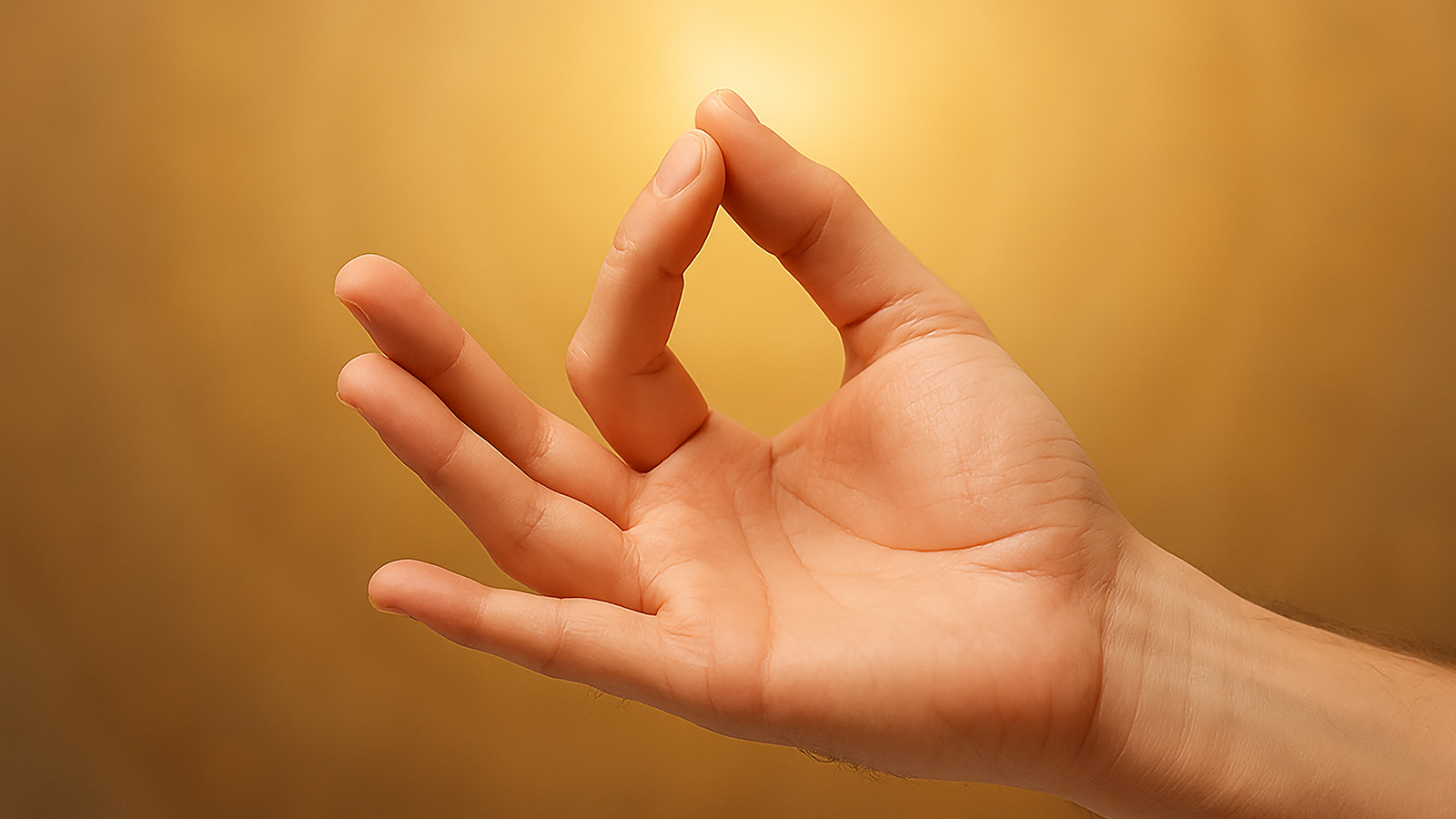
- Gently touch the tip of the index finger to the tip of the thumb, forming a circle.
- Keep the other three fingers extended but relaxed, without tension.
- Close your eyes and turn your awareness inward.
- Breathe slowly and deeply, holding the gesture for 15 to 45 minutes.
- You may chant a mantra like Om or So’Ham for enhanced meditative absorption.
— Meaning & Symbolism :
Each finger in Yogic science represents one of the five elements (Pancha Mahabhutas):
Thumb – Fire (Agni)
Index finger – Air (Vayu)
When these two fingers touch, they bring harmony between fire and air elements, enhancing mental clarity, creativity, and intuition. The circle formed by the thumb and index finger also symbolizes the eternal cycle of life and knowledge — with no beginning and no end.
The extended three fingers represent the three Gunas:
Middle finger – Sattva (purity, harmony)
Ring finger – Rajas (activity, passion)
Little finger – Tamas (inertia, ignorance)
By lightly curving them away from the thumb, the Mudra signifies transcending the influence of these three qualities, entering the state of pure awareness.
— The Science of Gyan Mudra :
ound connection to yogic anatomy and pranic energy flow. This Mudra functions as a neurological and energetic circuit, influencing both the brain and the subtle body.
🔹 Elemental Science
As per Ayurveda and Yoga, the index finger represents the Vayu Tattva (air element), which governs movement — including the nervous system, breath, and thought processes. The thumb symbolizes the Agni Tattva (fire element) — the source of energy, transformation, and spiritual illumination.
When these two elements are joined in Gyan Mudra:
The air element is regulated, calming excessive mental activity.
The fire element activates subtle awareness, supporting insight and meditation.
This creates a closed energy loop that directs the prana inward, conserving and purifying it.
🔹 Nervous System & Brain Activation
Stimulates pressure points that are linked to the pituitary and pineal glands.
Enhances alpha brainwave activity, associated with calm alertness and creativity.
Improves synaptic efficiency — making learning, reflection, and inner inquiry sharper.
🔹 Pranic Pathways and Mudra Lock
In yogic physiology, energy flows through nadis — subtle channels of life force. Gyan Mudra works primarily through:
Ida and Pingala Nadis, balancing left and right brain energies.
It assists in activating Sushumna Nadi, the central channel — preparing the seeker for higher states of meditation.
By creating a bioenergetic seal (Mudra), Gyan Mudra prevents the dissipation of prana through the hands and redirects it upward, supporting dhyana (meditative absorption) and ultimately Samadhi (spiritual union).
— Physical And Mental Benefits :
✴️ Physical Benefits
Enhances brain function and cognitive clarity
Improves sleep patterns and reduces insomnia
Balances the air element (Vayu) in the body
Supports nervous system stability and neuroplasticity
✴️ Mental & Emotional Benefits
Increases concentration, memory, and focus
Reduces anxiety, overthinking, and emotional turbulence
Brings calmness and mental stillness
✴️ Spiritual Benefits
Aids in deep meditation (Dhyana) and inner absorption
Connects the practitioner to intuitive insight and higher knowledge
Opens the path to Jnana Yoga (the path of knowledge)
— When and How Long to Practice :
- Duration: Start with 15 minutes, and gradually increase to 30–45 minutes per session.
- Time of Day: Ideal during Brahma Muhurta (4 AM–6 AM), but can be done any time when the mind needs calm and clarity.
- You can also do it before bed to relax the mind and encourage restful sleep.
- Practice during Pranayama, Mantra Japa, or silent sitting.
— Chakra Activation and Elemental Balance:
- Gyan Mudra stimulates the Ajna Chakra (Third Eye Center), which governs intuition, insight, and mental clarity.It also balances the Vayu element, which controls movement, nervous system activity, and thought flow.
- A balanced air element brings lightness, flexibility, and joy — while excess air leads to anxiety or mental agitation.Gyan Mudra helps stabilize these tendencies and create inner harmony.
— Precautions to Keep in Mind :
- Keep the fingers relaxed — don’t apply pressure while forming the circle.
- Sit with a straight spine for proper energy flow.
- Avoid practicing with dirty or sweaty hands; cleanliness enhances the sacredness of the gesture.
- People with severe hand injuries or arthritis may use a support or modify the hand position.
— Wrapping Up :
Gyan Mudra is the gateway to inner wisdom.
A gentle touch of the thumb and index finger becomes a silent invocation of the soul’s truth. It teaches that knowledge is not something to be acquired — it is something to be remembered. Through regular practice, the mind begins to rest, the breath deepens, and the seeker touches the infinite source of insight within.