Blog

  • From Lethargy to Light: Yogic Techniques to Conquer Laziness and Maintain Self-Motivation

    From Lethargy to Light: Yogic Techniques to Conquer Laziness and Maintain Self-Motivation

    In today’s fast-paced world, staying productive and motivated often feels like a constant uphill battle. While deadlines loom and aspirations call, many people struggle with a persistent lack of energy, procrastination, or an inability to stay consistent. This deep-seated tiredness or lack of enthusiasm isn’t just physical — it’s often a more profound psychological or even spiritual fatigue that modern productivity tools can’t fix.
    That’s where the ancient wisdom of Yog offers a timeless and holistic solution. Yog doesn’t simply provide surface-level motivation; it helps eliminate the root causes of lethargy by restoring balance between body, mind, and energy. It aligns our inner system so that self-motivation arises naturally, not from pressure or guilt, but from within.
    Let’s explore how we can understand and overcome laziness through the lens of Yog, and adopt practices that not only energize the body but also awaken the spirit.

    — Understanding Lethargy Through the Yogic Lens

    In Yogic philosophy, the universe — including our own body and mind — operates under the influence of three primary energies or “gunas”: Sattva, Rajas, and Tamas.

    • Sattva is the energy of clarity, harmony, light, and balance.
    • Rajas is the energy of action, movement, desire, and restlessness.
    • Tamas is the energy of inertia, darkness, confusion, and heaviness.

    Lethargy is not merely a lack of physical stamina. It’s a sign that Tamas is dominating your inner environment. It shows up as procrastination, oversleeping, mental fog, lack of motivation, and sometimes even emotional numbness. In such a state, even thinking about a to-do list can feel overwhelming.

    The problem isn’t that you’re lazy — the problem is that your internal energies are out of alignment. Instead of fighting yourself, Yog invites you to observe, understand, and gently transform that energy.

    By gradually reducing tamas and increasing sattva through disciplined practices, laziness dissolves, and self-motivation flows in naturally. This is not a quick fix — it’s a genuine, lasting inner transformation.

    — The Yogic Path to Lasting Self-Motivation

    One of the core teachings of Yog is that energy precedes action. When our prana (vital energy) is stagnant or low, it isn’t easy to take inspired action. Modern society often tells us to push harder, hustle more, or find external motivation. But Yog teaches that true, lasting motivation comes not from outside inspiration, but from inner alignment.

    In the yogic path, self-motivation is a result of balanced gunas, especially the rise of sattva. When sattva dominates, you begin to feel light, alert, enthusiastic, and focused — not through willpower alone, but through the natural flow of energy.

    This is why Yog emphasizes consistency, discipline (tapas), and mindful living over sporadic bursts of motivation. It trains the body and mind to remain stable, alert, and connected to a deeper purpose.

    Through regular practice, you begin to experience the subtle but powerful difference between pushing yourself to do something and being pulled by purpose toward your Dharma.

    — Daily Yogic Practices to Beat Lethargy

    To overcome tamas and stimulate healthy inner energy, the body must move and breathe in specific ways. Yog offers a perfect toolbox for this: Asanas (postures), Pranayama (breathwork), and Mudras (gestures).

    Energizing Asanas

    Specific yoga postures are particularly beneficial in stimulating the nervous system, enhancing blood circulation, and alleviating inertia.

    • Surya Namaskar (Sun Salutation): This is a full-body energizing sequence that synchronizes breath with movement, promoting overall well-being and vitality. Practicing 5 to 12 rounds in the morning increases metabolism, warms up the spine, and kickstarts both body and mind into action.
    • Tadasana (Mountain Pose): Though simple, this pose teaches you to stand tall with awareness. It helps improve posture, breath awareness, and grounding.
    • Dhanurasana (Bow Pose): This backbend opens the chest, activates digestion, and removes physical sluggishness.
    • Ustrasana (Camel Pose): A powerful heart-opening pose that invigorates the spinal cord and boosts emotional well-being.

    Practicing these asanas for just 15–30 minutes daily can help reprogram your body from a state of dormancy to one of alertness. The key is not intensity, but regularity.

    — Awakening Breath with Pranayama

    Breath is prana, and tamas thrives when prana is blocked or low. The proper pranayama techniques can lift energy almost instantly.

    • Bhastrika (Bellows Breath): This fast, forceful breath helps remove phlegm, awaken inner fire, and oxygenate the brain.
    • Kapalbhati (Skull-Shining Breath): A detoxifying technique that clears brain fog and sharpens mental alertness.
    • Nadi Shodhana (Alternate Nostril Breathing): Balances both hemispheres of the brain, reduces anxiety, and restores mental clarity.

    Start slow. Even 5 minutes a day can create profound shifts in energy. Over time, these breathing practices help dissolve the heavy layer of tamas from the nervous system, instilling clarity and drive.

    — Mudras for Motivation

    Hand gestures, or mudras, can stimulate energy pathways in the body and affect mood and vitality.

    • Prana Mudra: Made by touching the tips of the ring and little fingers to the thumb, it activates dormant energy and strengthens immunity.
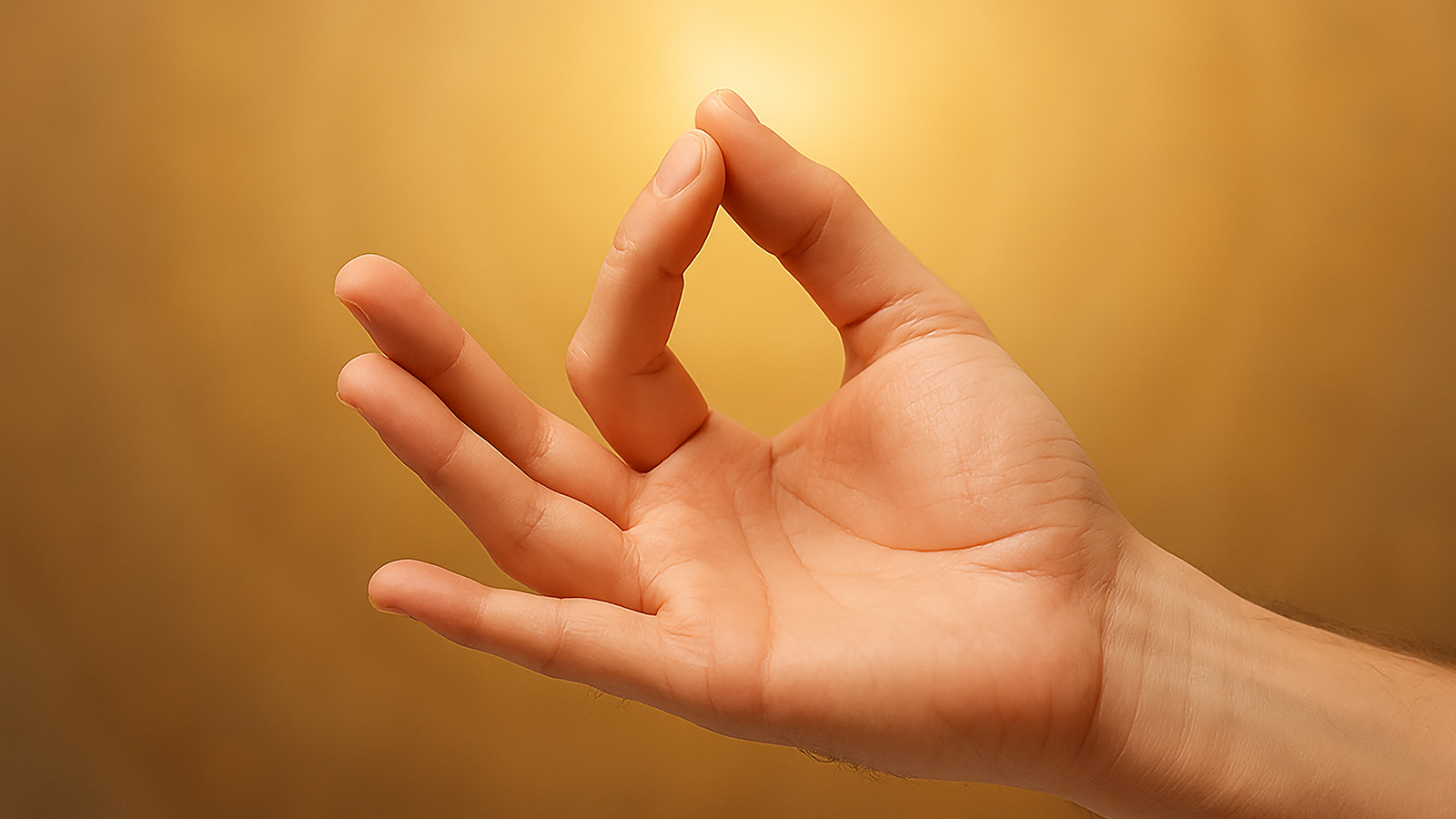
    • Gyan Mudra: The classic mudra for wisdom, it enhances focus and clarity when practiced in conjunction with meditation.

    Mudras are subtle yet powerful and can be practiced at any time, whether sitting, working, or walking.

    — Yogic Lifestyle Habits to Stay Energetic All Day

    True transformation happens not just on the mat, but in how we live moment to moment. The Yogic lifestyle is designed to minimize tamas and cultivate sattva — the state in which self-motivation becomes natural and effortless.

    Wake Up During Brahmamuhurta

    The time between 3:30 am and 5:30 am is considered Brahmamuhurta — the most spiritually potent part of the day. Waking during this period helps align your biological clock with cosmic rhythms. The mind is calm, and the air is rich with prana. Starting your day in this window with yoga, pranayama, or silence sets the tone for alertness and purpose.

    Follow a Sattvic Diet

    What you eat directly influences your energy levels and state of mind. A Sattvic diet is light, fresh, and filled with life force energy, or prana. It includes fruits, vegetables, whole grains, nuts, seeds, dairy (in moderation), and herbal teas.

    Avoid heavy, fried, leftover, or excessively spicy and sweet foods, as they increase tamas. Also, avoid cold milk at night, especially if you suffer from conditions like diabetes — it can increase mucus and sluggishness.

    Eating at regular intervals, chewing slowly, and being mindful during meals are subtle yet powerful practices that can boost pranic absorption and digestion.

    Maintain Clean Surroundings

    According to the Yogic principle of saucha (cleanliness), your external environment affects your internal state. A cluttered or dirty space increases the quality of tamas. Clean, organized, and serene surroundings foster sattva and make it easier to stay mentally clear and motivated.

    Limit Digital Overload

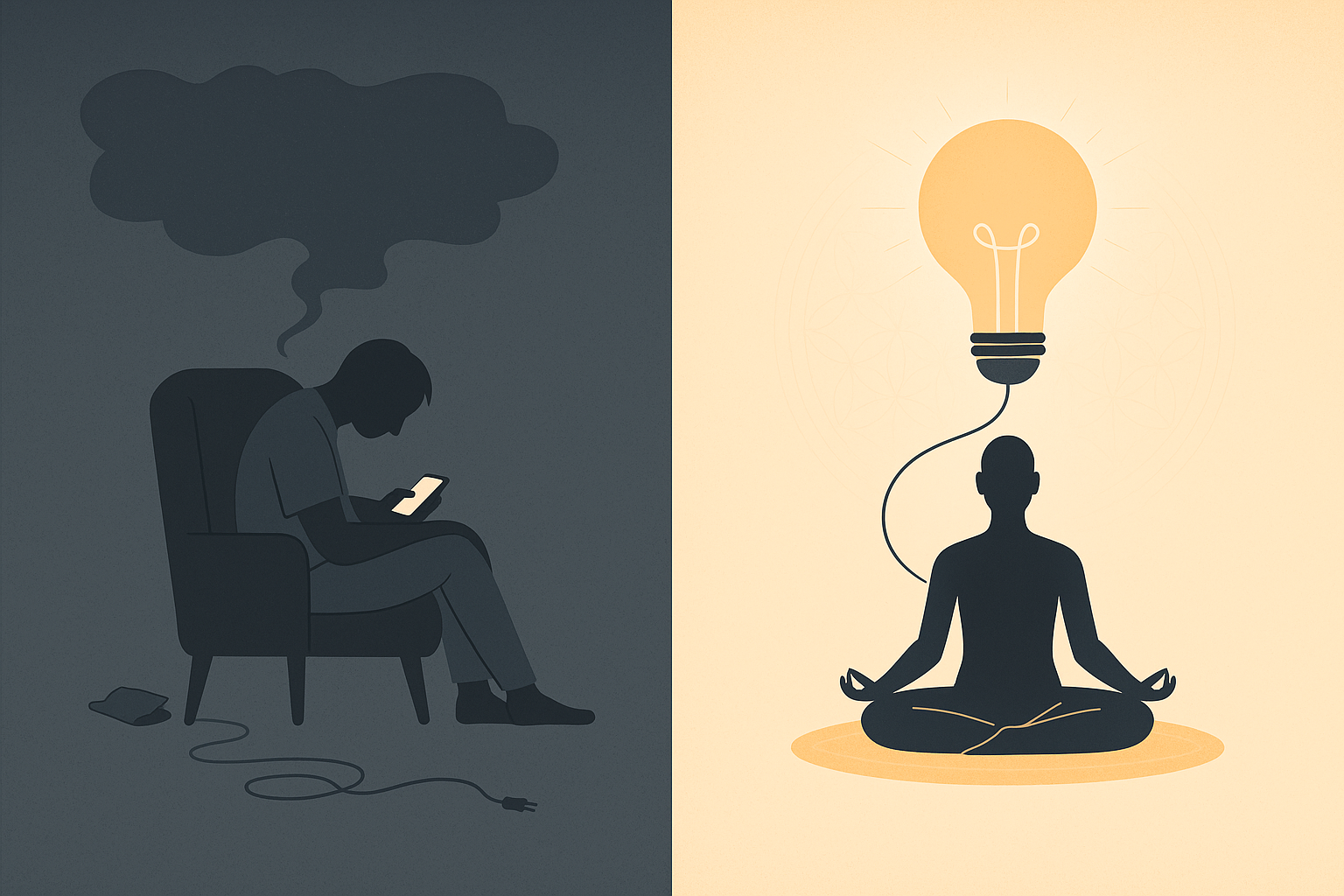
    Today’s screen-heavy lifestyle constantly bombards the mind with fragmented attention. Overconsumption of social media, especially mindless scrolling, directly feeds tamas. Schedule time away from screens — and when you do engage, choose uplifting content.

    Use your phone as a tool, not a trap. A short daily digital detox can renew your energy more than an hour-long nap.

    Engage in Seva (Selfless Service)

    Helping others without expectation softens the ego and invites inner joy. Seva (service) is one of the most underrated ways to overcome lethargy. When we work for others, the heart opens and tamas dissolves into purposeful action.

    — Mind Training Through Dhyana (Meditation) and Sankalpa

    Even when your body is active and your habits are clean, the mind can remain unfocused or restless. This is where Dhyana (meditation) comes in. It is the most subtle and powerful tool to train the mind to observe its patterns, reprogram limiting beliefs, and stay connected to inner clarity.

    Just 10–20 minutes of meditation each morning helps quiet the noise of distractions and align your actions with higher intention.

    Pair meditation with a Sankalpa — a positive, affirming statement of intent. Unlike resolutions driven by pressure, a Sankalpa is planted in the meditative state, where the subconscious mind is most receptive.

    Examples:

    • “I move through my day with clarity and enthusiasm.”
    • “My energy flows freely and purposefully.”
    • “I act with commitment, not just emotion.”

    This daily practice of Dhyana and Sankalpa creates a self-sustaining source of motivation. You no longer chase productivity; instead, you become a source of calm, focused energy.

    Adding Japa (mantra repetition) — such as “Om Namah Shivaya” or “So Hum” — further anchors your attention and elevates your frequency.

    — What to do on Days You Still Feel Unmotivated

    Despite best efforts, there will be days when energy dips. You may feel like skipping practice, staying in bed, or losing hope. That’s okay. Even nature has its winter. What matters is how you respond.

    Yog doesn’t promise that motivation will be constant. It teaches that you don’t need motivation to act — you only need Tapas.

    Tapas, or inner discipline, is the sacred fire that keeps you walking even when you don’t feel like it. It’s not rigid or punishing. It’s loving, respectful self-discipline that says, “I honor my path even when it’s hard.”

    On tough days:

    • Do a lighter practice instead of skipping entirely.
    • Sit in stillness even for 2 minutes.
    • Repeat your Sankalpa or mantra silently.
    • Remember that action leads to energy, not the other way around.

    Quote from the Bhagavad Gita:

    “You have the right to perform your prescribed duties, but you are not entitled to the fruits of your actions.”

    (Karmanye Vadhikaraste Ma Phaleshu Kadachana – BG 2.47)

    Focus on the action, not the outcome. One step a day — that’s enough.

    — Wrapping Up: Turn Inertia Into Inner Light

    Overcoming laziness isn’t about fighting yourself; it’s about embracing a new perspective. It’s about creating the conditions for your energy to rise, naturally and gently.

    Through Yog, you learn to transform tamas into movement, rajas into conscious effort, and finally awaken sattva — the light of clarity, joy, and inspiration. The tools are ancient, but their application is timeless: move your body with intention, breathe deeply, eat consciously, think clearly, serve humbly, and sit in silence.

  • Travel is a Return to the Self – A Yogic Perspective

    Travel is a Return to the Self – A Yogic Perspective

    “Not every journey begins with a ticket—some begin in silence, barefoot within.”

    In today’s world, travel is often marketed as a luxury or escape—a chance to break free from monotony and recharge in new surroundings. But what if we reimagined travel not as running away from life, but as a profound journey back into it? At YogRavi, we offer a unique perspective on travel: it’s a sacred opportunity to return to your center, to discover what’s essential, and to listen to the inner voice that daily noise often drowns out.

    — Rediscovering Yourself Through Local Adventures

    You don’t need a plane ticket to explore the unknown. Sometimes, the most profound journeys begin right outside your door. Rediscover the hidden treasures of your local surroundings. Walk through the park you haven’t visited in years. Observe the trees, the sounds, the shifting sky. Talk to the street vendor. Sit in a family-run cafe and taste food made with love. Each step is a discovery, a chance to see the familiar with fresh eyes.

    Each local adventure is an opportunity to reconnect with your surroundings and, more importantly, yourself. Yogic living invites awareness, and these micro-journeys become a daily form of meditation, helping you see the familiar through awakened eyes.

    — Finding Spiritual Growth in Your Backyard

    Sacredness doesn’t require distance—it needs depth. The divine can be experienced on your rooftop at sunrise or under a tree in your neighborhood park. Visit a local place of worship or create a moment of stillness in nature. These intimate spiritual experiences, when approached with sincerity, can lead to powerful personal transformation.

    When you take your yoga off the mat and into your natural surroundings, you realize that spiritual growth isn’t limited to temples or ashrams—it blossoms wherever there is presence.

    — How Traveling to Unseen Places Reflects Inner Transformation

    When you venture beyond your routine—whether to a secluded beach, a mountain cabin, or an unexplored trail—you meet parts of yourself that routine often conceals. These unseen places reflect your hidden potential. The awkwardness of navigating a new city, the joy of finding silence in nature, or the surprise of a stranger’s kindness all become mirrors of your inner growth.

    True transformation occurs not just in the external beauty you witness but in the shifts within—in perspective, patience, humility, and compassion. Travel, when engaged mindfully, is a mirror to your inner path.

    — The Art of Mindful Travel: Journeying Within

    The yogic way of travel is not fast or frantic. It is intentional and slow. Whether walking through a forest or a bustling market, bring your full attention to the experience. Notice the scent in the air, the rhythm of your steps, the emotion each place evokes. Each moment becomes a space for awareness.

    This kind of mindful presence aligns with the yogic practices of pratyahara (sense withdrawal) and dharana (concentration). You’re not just watching the world—you’re watching yourself within the world. Travel becomes a meditation in motion.

    — Navigating Emotional Landscapes While Traveling Alone

    Solo travel provides a unique opportunity to explore your inner self. In the absence of familiar people and comforts, you begin to listen more deeply to your thoughts and emotions. The quiet solitude of a forest trail or the anonymity of a city street gives space for feelings to arise and be observed without judgment. This emotional journey is as real as the physical ones, and in yoga, it’s known as svadhyaya, or self-inquiry. You learn what brings you peace, what triggers you, and what grounds you. And through this inner dialogue, solo travel becomes a powerful tool for healing and integration.

    These emotional landscapes are as real as the physical ones. In yoga, this practice is known as svadhyaya, which involves self-inquiry. You learn what brings you peace, what triggers you, and what grounds you. And through this inner dialogue, solo travel becomes a powerful tool for healing and integration. It’s a journey of self-discovery, a chance to understand yourself in ways you never thought possible.

    The yogic way of travel is not fast or frantic. It is intentional and slow. Whether walking through a forest or a bustling market, bring your full attention to the experience. Notice the scent in the air, the rhythm of your steps, the emotion each place evokes. Each moment becomes a space for awareness.

    This kind of mindful presence aligns with the yogic practices of pratyahara (sense withdrawal) and dharana (concentration). You’re not just watching the world—you’re watching yourself within the world. Travel becomes a meditation in motion.

    — Wrapping Up: Travel as a Return to the Self

    At its deepest level, travel is not about ticking places off a list. It is about presence, growth, and awareness. It is about peeling away distractions until you are face-to-face with your essence. Through mindful movement and yogic intention, you realize that the actual destination is not a city, a mountain, or a beach—it is the self. So, whether you’re planning a distant retreat or simply taking a walk around your block, bring your awareness with you. Let each step be sacred. Let each moment bring you closer to the truth within. This medium, dear seeker, is the essence of the yogic journey.

    So, whether you’re planning a distant retreat or simply taking a walk around your block, bring your awareness with you. Let each step be sacred. Let each moment bring you closer to the truth within.

    “Travel not to escape your life, but to remember who you are beneath it all. That, dear seeker, is the yogic journey”.

    — YogRavi

  • Don’t Wait for the Right Time – Walk When Dharma Calls

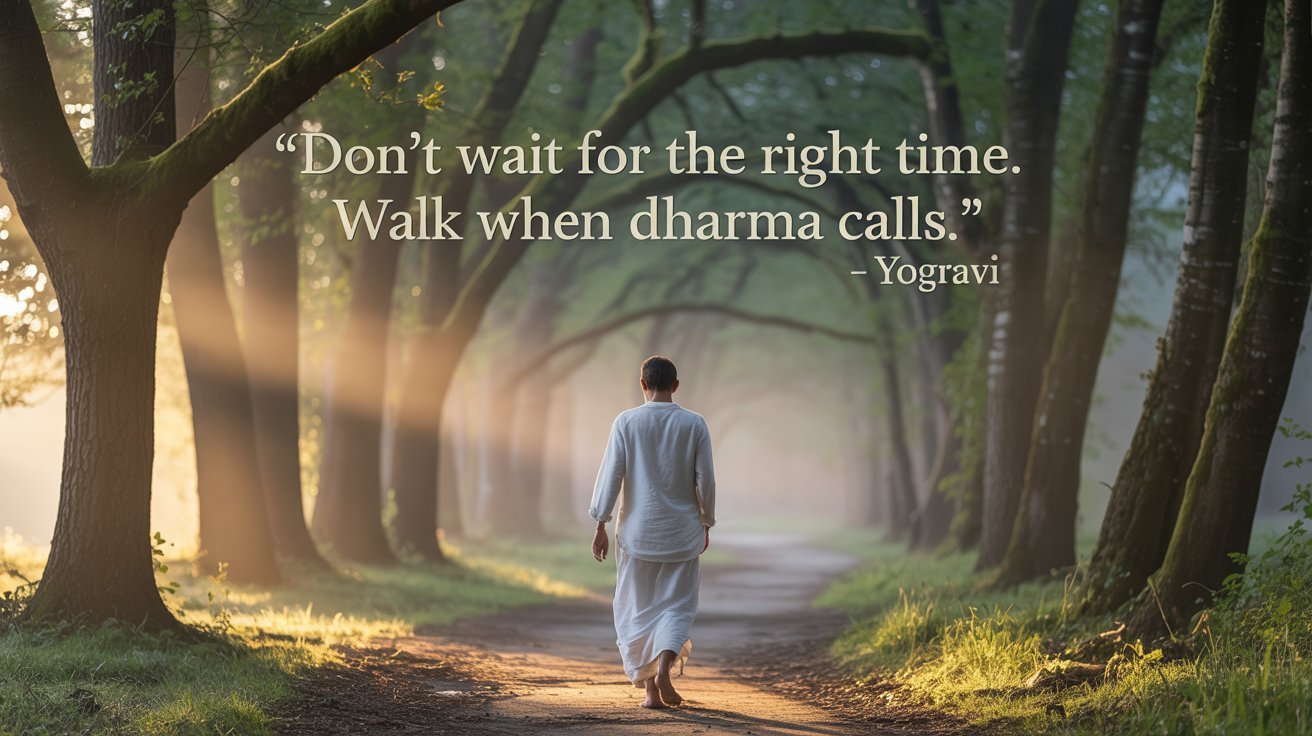
    Don’t Wait for the Right Time – Walk When Dharma Calls

    — Introduction: The Illusion of the Right Time

    We live in a world that constantly tells us to wait. Wait until you are more stable, wait until you have more money, wait until you feel confident, or until the stars align and the world gives you a sign. This idea of the “right time” has become a culturally accepted excuse to delay our dreams, our goals, and, most dangerously, our purpose. But what if this so-called “perfect moment” is nothing more than a myth? What if waiting is the very thing that keeps us from growing, evolving, and living the life we were born to live? In Yogic philosophy, the calling of Dharma does not arrive when it is most convenient. It comes when it must. It is not a whisper you can ignore or a duty you can postpone without consequence. Dharma is the inner fire, the soul’s compass, and when it calls, it demands a response, not hesitation.

    — Understanding Dharma: The Soul’s Purpose

    The concept of Dharma originates from the Sanskrit root “dhri,” meaning to uphold, sustain, or support. In the grand design of the universe, Dharma is the principle that maintains cosmic order. But on a profoundly personal level, Dharma is your unique purpose; it is the essential truth that your life is meant to express. It is not a job title or a set of tasks; it is the path that aligns with your soul’s most profound truth. In the Bhagavad Gita, Lord Krishna speaks to Arjuna on the battlefield of Kurukshetra, urging him to perform his duty as a warrior. Although Arjuna is paralyzed by moral confusion and fear, Krishna reminds him that one’s own Dharma, though fraught with challenges, is far superior to mimicking someone else’s path, even if that path appears easier or more glamorous. When you walk your Dharma, you align with the laws of the universe. Move with the current of life and not against it.

    — The Trap of Waiting: A Spiritual Paralysis

    One of the most significant obstacles on the spiritual path is the illusion that time will one day be just right. Such a mindset can lead to spiritual stagnation. It keeps us locked in a perpetual state of planning, analyzing, and doubting. We tell ourselves stories like, “I’ll start after the kids grow up,” or “once I save enough money,” or “when I feel more confident.” However, the truth is that the mind can always find another reason to delay. Inaction is seductive because it feels safe, but safety is not the same as growth. Growth is uncomfortable. It requires movement, and movement invites uncertainty. But it is in this uncertainty that Dharma reveals itself. By refusing to act, we not only delay our spiritual evolution, but we also miss the unique windows of opportunity that the universe presents. Each moment you delay your Dharma, you step further away from the very life your soul longs to live.

    — Recognizing the Call: Signs from Within

    Dharma rarely arrives with loud announcements or perfect clarity. Instead, it often comes as a soft but persistent nudge—a gentle inner tug that persists. You may sense a deep restlessness or dissatisfaction with your current life, even if things appear outwardly successful. Perhaps there’s a repeated idea or dream that keeps surfacing, or an inner voice urging you toward something greater. These are not random thoughts—they are the whispers of your soul. The universe speaks through signs, synchronicities, recurring patterns, or an unshakable inner knowing. At times, your external world may even begin to feel misaligned, as if your spirit no longer fits in the roles you’re playing. This discontent is not something to fear; it is a signal. Dharma doesn’t always make logical sense—it transcends logic. Learning to recognize and honor these subtle signals is a sacred skill. Meditation, silence, and self-inquiry are tools that sharpen your ability to listen. When your Dharma calls, it may not be convenient, but it will always be truthful.

    — Examples from the Great Souls

    Throughout history, those who have left a lasting impact did not wait for the ideal moment to begin. Though paralyzed by the prospect of battle, Arjuna awakened to his dharma through Krishna’s counsel. Swami Vivekananda did not wait until he was older or more established. He followed the inner command and addressed the Parliament of Religions in Chicago, awakening the spiritual identity of India on a global stage. Sri Aurobindo, once a political revolutionary, turned inward when his soul called for a higher purpose. Despite imprisonment and isolation, he emerged as one of India’s greatest spiritual philosophers, dedicating his life to the evolution of consciousness and the practice of integral Yoga. These luminaries didn’t act because the path was easy; they worked because the call was actual. Their lives are testimonies to the power of Dharma when one chooses to walk despite the odds, uncertainties, or societal expectations.

    — Dharma and Karma: The Yogic Connection

    In the philosophy of Yoga, Dharma and Karma are deeply interconnected. Karma refers to the actions you take and their results, while Dharma refers to the righteousness or alignment of those actions. You could spend a lifetime accumulating karma through various deeds, but unless those actions align with your Dharma, they don’t necessarily lead to spiritual progress. Misaligned actions can lead to greater restrictions or limitations. On the other hand, even the smallest step taken on the path of Dharma purifies karma and accelerates spiritual growth. This is why Lord Krishna emphasizes in the Gita that one must perform one’s prescribed duty without attachment to results. The goal is not to be perfect but to be sincere. Dharma is the channel through which karma transforms into liberation. To put it simply, Karma is the action, and Dharma is the intention behind the action. Understanding this relationship is essential for living in harmony with your true purpose.

    — How to Begin – Even If You’re Not Ready

    Many spiritual seekers mistakenly believe they must be completely ready before responding to the call of Dharma. This mindset can be a subtle form of avoidance, dressed as practicality. The truth is, readiness is rarely a prerequisite for beginning a soul-aligned path. It is through the very act of beginning—despite fear, doubt, or imperfection—that clarity and strength emerge. Start by listening to your intuition, even if it speaks softly. Write down what you feel called toward, even if you don’t fully understand why. Take one small, concrete step: read a book, enroll in a class, speak your truth to a trusted friend. Don’t wait for your confidence to arrive before taking action; instead, take action and let confidence catch up. Every step, no matter how uncertain, becomes an offering to the divine. Dharma honors sincerity more than perfection. Trust that once you begin, the universe will conspire to support you in ways you cannot yet see.

    — The Transformation That Follows

    When you finally step onto the path of Dharma, life changes. You begin to experience a more profound sense of alignment—your energy increases. Your doubts diminish. You stop asking for permission to be who you are. Challenges still arise, but they no longer paralyze you. Instead, they refine you. Synchronicities become more common. You meet people who support your growth and development. You attract opportunities that feel tailor-made for your journey. The outer world begins to reflect the clarity of your inner world. This is not magic; this is alignment. When you walk into Dharma, life supports you. Not always with ease, but always with meaning. Even your pain begins to feel purposeful. Even your struggles start to feel sacred. You realize that you are not walking alone. The universe walks with you.

    — Affirmations to Anchor Your Journey

    Words carry power, mainly when spoken with intention. Use these affirmations to strengthen your commitment to your Dharma:

    • I trust the timing of my soul’s journey.
    • I walk my path with courage and clarity.
    • I release fear and welcome divine guidance.
    • I am in perfect harmony with my highest purpose.
    • I choose Dharma over comfort.

    Repeat them daily, especially in moments of doubt. Let them become the inner voice that drowns out hesitation.

    — Wrapping Up: Now Is the Time

    There comes a moment in every seeker’s life when the pain of staying the same becomes greater than the fear of change. That moment is sacred. It is the turning point. If you are reading this and feel the stirrings of something more profound, honor it. Do not wait. Do not negotiate with your soul. Dharma does not demand perfection; it asks for presence. It asks for sincerity. And most of all, it asks for action. Walk now, not because everything is ready, but because you are willing. Walk now, because your soul has waited long enough. Walk when Dharma calls, because that call is not just a voice from within—it is the voice of the divine inviting you home.

  • Apan Mudra: (अपान मुद्रा)

    Apan Mudra: (अपान मुद्रा)

    Apana Mudra, known in Sanskrit as अपान मुद्रा, is a powerful hand gesture or hasta mudra in yogic science that facilitates the body’s natural process of elimination and detoxification. It is often referred to as the Mudra of Digestion and Purification because of its significant influence on the Apana Vayu, the downward-moving energy within the body. In yogic physiology, Apana Vayu is one of the five prana vayus, responsible for eliminating waste and toxins through the lower regions of the body. Regular practice of Apana Mudra enhances this energy flow, making it an essential tool in promoting physical cleansing, mental release, and energetic grounding. It is especially valued in traditional yoga therapy for its ability to support digestive health, reproductive balance, and emotional clarity.

    — Steps to do Apan Mudra

    To perform Apana Mudra, sit comfortably in a stable meditative posture such as Sukhasana (Easy Pose), Padmasana (Lotus Pose), or even on a straight-backed chair if sitting on the floor is not feasible. Keep your spine erect, shoulders relaxed, and eyes gently closed to focus inward. Bring your hands to rest on your thighs with palms facing upward. Now, gently touch the tips of your thumb, middle finger, and ring finger together, forming a triangular junction. Keep the index finger and little finger extended outward, without strain. Maintain this mudra on both hands. Breathe slowly and deeply through the nose, allowing your mind to become calm and centered. You may hold this gesture for 15 to 30 minutes daily, either in one sitting or in smaller intervals of 5 to 10 minutes throughout the day. This practice can be enhanced when accompanied by meditation, pranayama, or silent introspection.

    — Meaning & Symbolism

    The term “Apana” in Sanskrit refers to the downward-moving force of prana responsible for elimination through the colon, urinary tract, reproductive system, and legs. Symbolically, Apana Mudra represents the act of letting go—whether it be physical waste, emotional burdens, or mental clutter. The combination of fingers in this mudra signifies an alignment of the fire (thumb), ether (middle finger), and earth (ring finger) elements, which collectively support the body’s processes of transformation, nourishment, and release. Spiritually, this gesture reminds the practitioner of the importance of grounding, cleansing, and renewal, aligning with the deeper yogic principle that purification is a prerequisite for spiritual growth.

    — The Science of the Mudra

    From the yogic and Ayurvedic standpoint, Apana Mudra works by stimulating the Apana Vayu, which governs the pelvic region, colon, kidneys, and reproductive organs. This energy helps in the elimination of urine, stool, menstrual fluids, and even childbirth. By activating this force, the mudra assists in regulating these vital functions and clears the energy blockages in the lower chakras. In the lens of Ayurveda, the gesture balances Vata and Kapha doshas, aiding in digestion and stabilizing the body’s metabolic and elimination processes. On a neurological level, touching specific fingertips creates a reflex stimulation of associated brain centers and nerve endings related to elimination, thereby subtly influencing hormonal secretions, muscular tone, and nerve conduction to the lower abdomen and pelvis. This integration of ancient wisdom and modern science highlights the mudra’s therapeutic relevance even today.

    — Benefits – Physical, Mental & Spiritual

    Apana Mudra offers a vast spectrum of benefits, particularly in supporting systems associated with elimination, reproduction, and emotional detox. Physically, it improves digestion, bowel movement, and kidney function. It provides relief from conditions such as constipation, indigestion, bloating, and urinary retention. Women benefit from its regulation of the menstrual cycle, as it soothes cramps and promotes hormonal balance. For those in later stages of pregnancy, the mudra is sometimes used under supervision to support smoother labor.

    Mentally, Apana Mudra helps in clearing out negative thoughts, anxiety, and accumulated stress. It fosters a state of release and surrender, promoting emotional catharsis and relaxation. Spiritually, the gesture is associated with cleansing of karma, releasing past emotional wounds, and grounding oneself to the Earth element. As the practitioner lets go of the unwanted, space is created for clarity, lightness, and inner growth.

    — When and How Long to Practice

    Apana Mudra can be practiced at any time of day, but it yields optimal results when done in the early morning on an empty stomach, or about 30–45 minutes after a meal, especially if digestive support is desired. The ideal duration for practice ranges between 15 to 30 minutes per day, but it may be broken into multiple shorter sessions depending on your routine. For those experiencing digestive discomfort or emotional heaviness, even a 5-minute practice post-meal or before bedtime can be therapeutic. Consistency is key—regular practice gradually builds subtle awareness and enhances its cumulative benefits.

    — Chakra Activation and Elemental Balance

    Apana Mudra strongly influences the Muladhara (Root Chakra) and the Swadhisthana (Sacral Chakra)—the energy centers responsible for survival, stability, elimination, sexuality, and creativity. By enhancing the flow of Apana Vayu, it supports grounding energy and emotional fluidity. In terms of elemental balance, the gesture harmonizes:

    Fire (Agni) – represented by the thumb, symbolizing transformation

    Ether (Akasha) – represented by the middle finger, linked to expansion and communication

    Earth (Prithvi) – represented by the ring finger, symbolizing stability and structure

    This trio of elements supports internal cleansing, helps burn and release toxins, and promotes grounded awareness essential for spiritual progression.

    — Precautions & Tips

    While Apana Mudra is generally safe and accessible to most people, there are a few precautions to keep in mind. Individuals suffering from chronic diarrhea, excessive menstrual bleeding, or extreme depletion of energy should avoid over-practicing this mudra. Pregnant women should only practice it under the guidance of a qualified yoga teacher or therapist, especially in the third trimester, when it may assist in childbirth if used mindfully. Always ensure that the breath remains deep and natural, and avoid clenching the fingers or practicing with force. For enhanced effectiveness, combine Apana Mudra with grounding practices such as walking barefoot on natural ground or performing seated meditation.

    — Wrapping Up:

    Apana Mudra is a transformative yogic practice that empowers the body and mind to release what no longer serves. It embodies the principle that true wellness begins with purification, not only at the physical level but also mentally and spiritually. By aligning with the downward-moving force of Apana Vayu, this mudra aids in elimination, detoxification, and emotional clearing. Whether you seek digestive support, menstrual balance, or simply a deeper connection with your inner foundation, integrating Apana Mudra into your daily sadhana can bring about profound shifts in clarity, health, and grounded awareness. In a world full of accumulation—of stress, toxins, and distractions—this mudra offers a gentle, ancient solution: let go, and flow freely.

  • Pranav Mudra: प्रणव मुद्रा

    Pranav Mudra: प्रणव मुद्रा

    — Introduction :

    In the science of Pranayama, where each breath is a conscious offering to the divine, Pranav Mudra (प्रणव मुद्रा) aslo called as ‘Vishnu Mudra’ (विष्णु मुद्रा) in other scriptural texts, just as Lord Vishnu sustains the cosmos, Vishnu Mudra sustains the inner universe of prana, keeping the breath centered, the energy balanced, and the mind calm. This Mudra is not a symbolic or meditative gesture, but a functional hand position specifically used to control the nostrils during Anulom Vilom or Nadi Shodhana Pranayama. The term “Pranav” refers to the sacred sound Om (ॐ), that’s why it is also called as ‘Om Mudra’ (ॐ मुद्रा) — the primordial vibration. By extension, this Mudra becomes the gateway for guiding the pranic flow through alternate nostril breathing, preparing the subtle body for purification and inner stillness.

    Although not always named explicitly in ancient texts, this Mudra has become a cornerstone in modern yogic breathing practices. It enables smooth nostril switching, keeps the breath intentional, and aligns physical gesture with pranic discipline.

    — Step-by-step Instructions :

    1. Sit in a stable meditative posture like Padmasana, Sukhasana, or Vajrasana.

    2. Bring your right hand up near your nose.

    3. Gently fold the index and middle fingers inward so that they touch the palm.

    4. Keep the thumb, ring finger, and little finger extended.

    5. Use the thumb to close the right nostril and the ring or little finger to close the left nostril, alternating as needed.

    6. Rest your left hand on the knee in Gyan Mudra or Chin Mudra.

    7. Begin Anulom Vilom Pranayama, using Pranav Mudra to guide the nostril control rhythmically.

    🔊 The key is gentle pressure and smooth switching between nostrils without strain.

    — Meaning & Symbolism :

    While this Mudra is primarily functional, its name — Pranav — ties it deeply to the spiritual essence of Om. In Yogic philosophy, Om (Pranava) is the sound form of consciousness. The act of controlling the breath using this Mudra symbolizes the practitioner’s command over prana, aligning body, breath, and mind with the universal vibration.

    It represents:

    • Mastery over pranic duality (Ida and Pingala)

    • A bridge between outer breath and inner silence

    • An invocation of the discipline of Yoga, where even the hand becomes a tool for awakening

    — The Science of Pranav Mudra:

    Mudra enhances the efficacy of alternate nostril breathing by providing precision and control. Here’s how it works:

    🔹 Neuromuscular Precision

    • Creates a stable hand shape that allows easy manipulation of nostrils

    • Reduces muscular fatigue compared to random hand positioning

    🔹 Pranic Flow Regulation

    • Ensures smooth activation of Ida Nadi (left nostril) and Pingala Nadi (right nostril)

    • Facilitates equal and conscious inhalation and exhalation

    🔹 Mental Focus

    • Acts as a mudra anchor that keeps the practitioner engaged in the breath cycle

    • Coordinates hand movement with mental awareness, building concentration (Dharana)

    By creating this rhythmic control, Pranav Mudra helps awaken the Sushumna Nadi, the central energy channel, through balanced breathing.

    — Benefits of Pranav Mudra:

    Physical Benefits:

    • Allows accurate nostril switching during Anulom Vilom

    • Reduces shoulder and wrist strain with ergonomic finger positioning

    • Improves lung efficiency by enabling full and equal breathing

    Mental & Emotional Benefits:

    • Increases breath awareness and mental focus

    • Anchors the mind to the practice, reducing mental distractions

    • Enhances discipline and mind-body coordination

    Spiritual Benefits:

    • Prepares the pranic field for deep meditation and inner absorption

    • Aligns breath with the sacred rhythm of Om

    • Supports the process of Nadi Shodhana (energy purification)

    — When and How Long to Practice :

    • Use Pranav Mudra only during Pranayama sessions that involve nostril control (e.g., Anulom Vilom, Nadi Shodhana).
    • Practice for 5 to 20 minutes based on your Pranayama schedule.
    • Ideal time: Brahma Muhurta (4–6 AM) or in the evening before meditation.
    • Should be practiced on an empty stomach and in a quiet, well-ventilated space.

    — Chakra Activation and Elemental Balance:

    While Pranav Mudra itself is not directly meditative, it aids in balancing the energy flow between Ida and Pingala Nadis, which are associated with:

    • Ida Nadi – linked to the Chandra (moon) energy and the left side of the body, calming, cooling, connected to Ajna Chakra.

    • Pingala Nadi – linked to the Surya (sun) energy and the right side, energizing and warming.

    By balancing these, Pranav Mudra indirectly activates the Sushumna Nadi, preparing for chakra alignment, especially the Ajna (third eye) and Sahasrara (crown) centers.

    Elementally, it harmonizes:

    • Vayu (air) through controlled breathing

    • Agni (fire) through thumb usage, representing transformation

    — Precautions to Keep in Mind :

    • Do not apply force while pressing the nostrils — keep it gentle and rhythmic.

    • If your hand or shoulder feels strained, support the elbow with the other hand or a cushion.

    • Avoid practicing when suffering from cold, nasal congestion, or severe migraines.

    • Ensure fingers are clean and relaxed to maintain sacredness and comfort.

    — Wrapping Up :

    Pranav Mudra is a gesture of discipline, precision, and breath mastery. It may appear simple, but it plays a pivotal role in the success of Anulom Vilom and other nostril-based Pranayama practices. As the right hand forms this Mudra, the breath begins to flow with intention. In this sacred act, duality dissolves, and the practitioner is drawn inward — toward silence, stillness, and the subtle resonance of Om.

  • Gyan Mudra: ज्ञान मुद्रा -(The Mudra of Wisdom)

    Gyan Mudra: ज्ञान मुद्रा -(The Mudra of Wisdom)

    — Introduction :

    Gyan Mudra (ज्ञान मुद्रा), also known as the Mudra of Knowledge, is one of the most commonly practiced hand gestures in Yoga and meditation. The word Gyan means wisdom or spiritual knowledge, and this Mudra symbolizes the union of individual consciousness with universal consciousness. It is frequently seen in statues of sages and deities seated in deep meditation, symbolizing inner awakening and mastery over the mind.

    In yogic philosophy, Gyan Mudra helps balance the air element (Vayu) in the body and stimulates the brain and nervous system. It is associated with improved focus, deeper meditation, and spiritual growth. This simple hand gesture, when performed with awareness, becomes a powerful tool for calming the mind and accessing higher states of consciousness.

    — Step-by-step Instructions :

    1. Sit in a meditative posture such as Padmasana, Siddhasana, or Vajrasana. You can also sit comfortably on a chair with your spine straight.
    2. Rest your hands on your knees with palms facing upward.
    3. Gently touch the tip of the index finger to the tip of the thumb, forming a circle.
    4. Keep the other three fingers extended but relaxed, without tension.
    5. Close your eyes and turn your awareness inward.
    6. Breathe slowly and deeply, holding the gesture for 15 to 45 minutes.
    7. You may chant a mantra like Om or So’Ham for enhanced meditative absorption.

    — Meaning & Symbolism :

    Each finger in Yogic science represents one of the five elements (Pancha Mahabhutas):

    • Thumb – Fire (Agni)

    • Index finger – Air (Vayu)

    When these two fingers touch, they bring harmony between fire and air elements, enhancing mental clarity, creativity, and intuition. The circle formed by the thumb and index finger also symbolizes the eternal cycle of life and knowledge — with no beginning and no end.

    The extended three fingers represent the three Gunas:

    • Middle finger – Sattva (purity, harmony)

    • Ring finger – Rajas (activity, passion)

    • Little finger – Tamas (inertia, ignorance)

    By lightly curving them away from the thumb, the Mudra signifies transcending the influence of these three qualities, entering the state of pure awareness.

    — The Science of Gyan Mudra :

    ound connection to yogic anatomy and pranic energy flow. This Mudra functions as a neurological and energetic circuit, influencing both the brain and the subtle body.

    🔹 Elemental Science

    As per Ayurveda and Yoga, the index finger represents the Vayu Tattva (air element), which governs movement — including the nervous system, breath, and thought processes. The thumb symbolizes the Agni Tattva (fire element) — the source of energy, transformation, and spiritual illumination.

    When these two elements are joined in Gyan Mudra:

    • The air element is regulated, calming excessive mental activity.

    • The fire element activates subtle awareness, supporting insight and meditation.

    • This creates a closed energy loop that directs the prana inward, conserving and purifying it.

    🔹 Nervous System & Brain Activation

    • Stimulates pressure points that are linked to the pituitary and pineal glands.

    • Enhances alpha brainwave activity, associated with calm alertness and creativity.

    • Improves synaptic efficiency — making learning, reflection, and inner inquiry sharper.

    🔹 Pranic Pathways and Mudra Lock

    In yogic physiology, energy flows through nadis — subtle channels of life force. Gyan Mudra works primarily through:

    • Ida and Pingala Nadis, balancing left and right brain energies.

    • It assists in activating Sushumna Nadi, the central channel — preparing the seeker for higher states of meditation.

    By creating a bioenergetic seal (Mudra), Gyan Mudra prevents the dissipation of prana through the hands and redirects it upward, supporting dhyana (meditative absorption) and ultimately Samadhi (spiritual union).

    — Physical And Mental Benefits :

    ✴️ Physical Benefits

    • Enhances brain function and cognitive clarity

    • Improves sleep patterns and reduces insomnia

    • Balances the air element (Vayu) in the body

    • Supports nervous system stability and neuroplasticity

    ✴️ Mental & Emotional Benefits

    • Increases concentration, memory, and focus

    • Reduces anxiety, overthinking, and emotional turbulence

    • Brings calmness and mental stillness

    ✴️ Spiritual Benefits

    • Aids in deep meditation (Dhyana) and inner absorption

    • Connects the practitioner to intuitive insight and higher knowledge

    • Opens the path to Jnana Yoga (the path of knowledge)

    — When and How Long to Practice :

    • Duration: Start with 15 minutes, and gradually increase to 30–45 minutes per session.
    • Time of Day: Ideal during Brahma Muhurta (4 AM–6 AM), but can be done any time when the mind needs calm and clarity.
    • You can also do it before bed to relax the mind and encourage restful sleep.
    • Practice during Pranayama, Mantra Japa, or silent sitting.

    — Chakra Activation and Elemental Balance:

    • Gyan Mudra stimulates the Ajna Chakra (Third Eye Center), which governs intuition, insight, and mental clarity.It also balances the Vayu element, which controls movement, nervous system activity, and thought flow.
    • A balanced air element brings lightness, flexibility, and joy — while excess air leads to anxiety or mental agitation.Gyan Mudra helps stabilize these tendencies and create inner harmony.

    — Precautions to Keep in Mind :

    • Keep the fingers relaxed — don’t apply pressure while forming the circle.
    • Sit with a straight spine for proper energy flow.
    • Avoid practicing with dirty or sweaty hands; cleanliness enhances the sacredness of the gesture.
    • People with severe hand injuries or arthritis may use a support or modify the hand position.

    — Wrapping Up :

    Gyan Mudra is the gateway to inner wisdom.
    A gentle touch of the thumb and index finger becomes a silent invocation of the soul’s truth. It teaches that knowledge is not something to be acquired — it is something to be remembered. Through regular practice, the mind begins to rest, the breath deepens, and the seeker touches the infinite source of insight within.