Blog

  • Bhastrika Pranayam (भस्त्रिका प्राणायाम)

    Bhastrika Pranayam (भस्त्रिका प्राणायाम)

    — Introduction :

    Bhastrika Pranayam, often referred to as the “bellows breath,” is a powerful and energizing yogic breathing technique that ignites the digestive fire (Jatharagni), awakens the Pranic force, and purifies the entire system from within. The Sanskrit word Bhastrika means “bellows,” symbolizing the rhythmic and forceful movement of the lungs, much like the bellows used to stoke a fire. In this way, Bhastrika is not just a breath technique—it is a method of internal alchemy, where the body is revitalized and the mind is sharpened.

    Ancient yogis practiced Bhastrika to awaken dormant energy, clear stagnation, and dissolve impurities lodged in the physical and subtle channels. It combines both vigorous inhalation and exhalation, followed by breath retention, making it both a stimulating and meditative practice. Its effect is to energize the solar nadi (Pingala), boost vitality, and prepare the practitioner for deeper practices such as Dharana (concentration), Dhyana (meditation), and even Kundalini awakening.

    Bhastrika is mentioned in classical texts like the Hatha Yoga Pradipika, where it is praised for its cleansing effects on the brain and sinuses, as well as its capacity to destroy excess phlegm and lethargy. As a bridge between body, energy, and awareness, Bhastrika awakens the inner fire and sets the spiritual journey ablaze.

    — Step-by-step Instructions :

    1. Sit in Padmasana, Sukhasana, or Vajrasana with spine erect
    2. Close the eyes and relax the body
    3. Inhale forcefully and deeply through both nostrils, expanding the chest fully
    4. Exhale forcefully and completely, using abdominal contraction
    5. Perform 10 rapid breaths (1 breath per second)
    6. After the last exhalation, inhale deeply and retain the breath (Antar Kumbhaka) as long as comfortably possible
    7. Exhale slowly and resume normal breathing
    8. This completes one round. Begin with 3 rounds, increasing as strength builds

    — Physical And Mental Benefits :

    • Activates digestive fire and improves metabolism
    • Clears excess mucus, phlegm, and toxins from the system
    • Strengthens the lungs and improves oxygen intake
    • Increases alertness, energy levels, and mental clarity
    • Balances Kapha dosha, and awakens the Pingala Nadi (solar energy)
    • Enhances stamina, willpower, and inner determination
    • Acts as a preparatory practice for Kundalini awakening in advanced sadhana

    — Precautions to Keep in Mind :

    • Avoid if suffering from high blood pressure, heart conditions, or epilepsy
    • Should not be practiced by pregnant women
    • Do not practice during fever, heatstroke, or excessive body heat
    • Begin slowly; avoid straining the lungs or forcing breath beyond comfort
    • People with respiratory issues should consult a qualified teacher or physician before beginning

    — Beginner’s Tips :

    • Start with slow forceful breathing, 5–10 breaths per round
    • Sit in a well-ventilated space
    • Keep the breath sound soft yet clear; no whistling
    • After each round, allow time for natural breath recovery
    • Practice in the morning to utilize its energizing qualities throughout the day

    — Best Time to Practice :

    • Best practiced in the early morning, when the body is fresh and the stomach is empty
    • Avoid during the hot part of the day or in summer heat
    • Do not perform after eating or before sleep
    • Practice in a calm, well-ventilated, and sacred space

     — Advanced Variations :

    • Gradually increase the number of breaths per round to 20 or 30, depending on capacity
    • Add Bandhas (Jalandhar Bandha and Moola Bandha) during breath retention

    — Wrapping Up :

    Bhastrika Pranayam is a powerful tool to ignite the inner fire, clear impurities, and awaken dormant energy. It prepares the body for higher spiritual practices by strengthening the lungs, energizing the nadis, and sharpening the mind. For those feeling heavy, dull, or mentally clouded, Bhastrika acts like a fresh wind of life. When practiced regularly, with awareness and devotion, it becomes a transformative breath that fans the flame of consciousness.
  • Nadi Shodhan Pranayam (नाड़ी शोधन प्राणायाम)

    Nadi Shodhan Pranayam (नाड़ी शोधन प्राणायाम)

    — Introduction :

    Nadi Shodhana, meaning “channel purification,” is one of the most revered and essential practices in the yogic science of breath. It is the art of cleansing the subtle energy pathways, or nadis, through conscious, alternate-nostril breathing. In classical yogic teachings, it is said that there are 72,000 nadis coursing through the astral body, with three major ones—Ida, Pingala, and Sushumna—playing a central role in physical, mental, and spiritual wellbeing.

    Nadi Shodhana Pranayam serves as the preparatory foundation for all higher pranayams, meditations, and inner yogic practices. By purifying the nadis, it removes energetic blockages, balances the flow of Pran (vital life force), and harmonizes the dual forces of the body—Ida, the lunar, cooling, introspective energy, and Pingala, the solar, warming, active energy. This harmonious flow allows for the activation of Sushumna Nadi, the central spiritual channel that leads toward higher states of consciousness and the awakening of Kundalini Shakti.

    Unlike some energizing or forceful breathwork, Nadi Shodhana is deeply calming and inward-drawing. It is a silent dialogue between the breath and the soul, encouraging the mind to settle into stillness. For seekers walking the path of Dhyana (meditation), Japa (mantra repetition), or Samadhi (absorption), Nadi Shodhana is indispensable.

    In ancient texts such as the Hatha Yoga Pradipika and Gheranda Samhita, Nadi Shodhana is emphasized as the first and foremost pranayam that should be mastered before proceeding to more advanced techniques. It brings mental clarity, purifies the senses, enhances inner peace, and sets the stage for subtle yogic transformation.

    — Step-by-step Instructions :

    1. Sit in a meditative posture such as Padmasana or Vajrasana
    2. Keep your spine erect and eyes closed, hands relaxed on the knees
    3. Form Nasika Mudra with the right hand (thumb and ring finger active)
    4. Close the right nostril with the thumb and inhale slowly through the left nostril
    5. Close the left nostril with the ring finger, release the thumb, and exhale through the right
    6. Inhale through the right, then switch and exhale through the left
    7. This completes one round. Practice 10 to 15 rounds, gradually increasing
    8. Breath should be smooth, silent, and effortless, without force or retention for beginners

    — Physical And Mental Benefits :

    • Deeply cleanses the nadis, enhancing energy flow and vitality
    • Brings balance to both brain hemispheres and the nervous system
    • Reduces stress, anxiety, and emotional instability
    • Improves focus, memory, and mental clarity
    • Prepares the body and mind for meditation and mantra sadhana
    • Stabilizes breathing patterns and supports inner stillness
    • Encourages the awakening of Sushumna Nadi, central to spiritual evolution

    — Precautions to Keep in Mind :

    • Avoid practicing with blocked nostrils, cold, or sinus issues
    • Breath should be gentle and without force—never strain or rush
    • Pregnant women or those with severe breathing disorders should consult a guide
    • Do not attempt breath retention (kumbhaka) unless guided and experienced
    • Always practice on an empty stomach in a calm, quiet space

    — Beginner’s Tips :

    • Begin with 5–10 minutes daily, preferably in the morning
    • Use a simple 1:1 ratio (equal inhalation and exhalation)
    • Focus on the sensation of breath and the movement of energy
    • Practice in silence and gradually develop awareness of Ida and Pingala
    • Be patient—this is a cleansing and preparatory practice that works over time

    — Best Time to Practice :

    • Ideally practiced during Brahma Muhurta (before sunrise)
    • Can also be practiced in the evening or before meditation
    • Maintain at least 3 hours gap after meals
    • Create a routine—consistency builds inner rhythm and clarity

     — Advanced Variations :

    • Mentally chant the So-Ham mantra during inhalation and exhalation

    — Wrapping Up :

    Nadi Shodhana is the sacred gateway to inner harmony. Through this gentle and balanced breathing, one gradually removes energetic obstructions, cultivates stillness, and begins to hear the silent whispers of the soul. It is more than a technique—it is a ritual of refinement, bringing the body, mind, and breath into alignment with the higher Self. Whether you are a seeker just beginning or an advanced yogi, Nadi Shodhana is a lifelong companion on the path of Yog.

  • Agarbh Anulom Vilom Pranayam – अगर्भ अनुलोम विलोम प्राणायाम

    Agarbh Anulom Vilom Pranayam – अगर्भ अनुलोम विलोम प्राणायाम

    — Introduction :

    Anulom Vilom Pranayam is a traditional yogic breathing technique that involves alternate nostril breathing to balance the body’s energy channels. It harmonizes the Ida and Pingala nadis, calms the mind, purifies the breath, and prepares the practitioner for deeper meditation. Regular practice brings inner balance, emotional stability, and mental clarity.

    Agarbh Anulom Vilom Pranayam is the foundational form of alternate nostril breathing, practiced without any mental engagement in mantra or seed syllables. The word Agarbh means “without seed,” signifying that this stage of the practice does not involve meditative focus or internal chanting. Its sole purpose is the purification of the physical nadis, the vital energy channels that carry Pran throughout the body.

    Ancient yogic texts describe over 72,000 nadis, and it is through these channels that our energy, thoughts, and health are regulated. Over time, due to lifestyle, emotions, and karmic impressions, these nadis become congested or imbalanced. Agarbh Anulom Vilom is the first step toward cleansing this inner system, using rhythmic and alternate nostril breathing to restore harmony between Ida and Pingala, the left and right energy flows.

    This practice is best suited for beginners and sincere aspirants who wish to build a solid foundation for deeper pranayams. As the physical channels become clear, the breath becomes smooth, the body light, and the mind naturally settles into silence. It prepares the ground for Sagarbh Anulom Vilom, where mantra and subtle awareness will be introduced for purification of the astral nadis.

    — Step-by-step Instructions :

    1. Sit in Padmasana or any stable meditative posture, facing east or north
    2. Keep the spine erect, eyes gently closed, and the body relaxed
    3. Form Nasika Mudra with your right hand
    4. Close the right nostril with the thumb and inhale slowly through the left nostril
    5. Close the left nostril with the ring finger, hold the breath comfortably
    6. Release the right nostril and exhale slowly through the right
    7. Now inhale through the right, retain the breath again, then exhale through the left
    8. This completes one round of Anulom Vilom
    9. Aim for 25 rounds per sitting, gradually building toward 75 rounds daily (morning, noon, evening)
    10. Duration should be guided by comfort and natural capacity, avoiding strain or gasping

    — Physical And Mental Benefits :

    • Deeply purifies the nadis and enhances Pranic flow
    • Prepares the body for deeper Asana and Dharana (concentration)
    • Promotes stillness of body and mind, essential for higher yogic practices
    • Balances the nervous system and both hemispheres of the brain
    • Establishes inner tranquility, steadiness, and meditative awareness
    • Supports emotional regulation and sharpens spiritual perception

    — Precautions to Keep in Mind :

    • Do not force breath retention; it must feel natural and comfortable
    • Avoid if suffering from cold, blocked nostrils, or respiratory conditions
    • Women should avoid long retention during menstruation or pregnancy
    • If you cannot complete 25 rounds at once, split the session into 10 and 15 rounds
    • Pranayam should always be practiced on an empty stomach in a calm, undisturbed setting

    — Beginner’s Tips :

    • Start with a few rounds and increase gradually as comfort improves
    • Keep the breath soft, smooth, and silent
    • Do not focus on mantra initially (Agarbh stage) – just observe the breath
    • Regularity is more important than duration—consistency brings purification
    • Track time by setting aside at least 25 minutes per sitting, even if you don’t count rounds

    — Best Time to Practice :

    • Practice ideally during Brahma Muhurta (before sunrise)
    • Other suggested times: midday and evening, for a total of three sittings daily
    • Avoid immediately after meals—allow at least 3 hours of digestion time
    • Choose a quiet, undisturbed, and spiritually charged space

     — Advanced Variations :

    • Sagarbh Anulom Vilom includes mental chanting of Beej Mantras during breath retention

    — Wrapping Up :

    Agarbh Anulom Vilom Pranayam is not just a technique—it is a sacred discipline to prepare body and mind for inner stillness and meditation. Begin with simple alternate-nostril breathing to cleanse the gross nadis. With patience and devotion, this practice leads to deeper purification and readiness for higher yogic states. As the breath flows evenly, the mind becomes still, and the seeker awakens to the divine presence within.

  • The Origin of Yog

    The Origin of Yog

    Yog, derived from the Sanskrit root word “Yuj” (युज्), meaning “to join,” “to unite,” or “to yoke,” is a profound spiritual discipline rooted in ancient Indian philosophy. The root “Yuj” is found in classical Sanskrit grammar and holds multiple contextual meanings such as yoking (as in attaching oxen to a cart), union, concentration, and integration. From this root, the noun “Yog” (योग) is formed, which refers to the union of the individual self (Atman) with the universal consciousness (Brahman). In broader terms, it implies the harmonious integration of body, mind, and spirit.

    Yog is a holistic approach that harmonizes these aspects through a system of physical postures (asans), breath control (pranayam), meditation (dhyan), and ethical practices. Far beyond just physical fitness, Yog serves as a path to inner clarity, emotional stability, and self-realization.

    — Origin of the Term “Yog” —

    The term Yog is derived from the Sanskrit root “yuj” (युज्). According to the grammatical treatise of Maharishi Panini, the root “yuj” holds three primary interpretations across different verb groups (dhatu-gan):

    • In the Rudhadi collection, it signifies union or joining (युजिर योगे),

    • In the Divadi collection, it means absorption or Samadhi,

    • And in the Churadi collection, it refers to restraint or control.

    Based on the first meaning, Yog implies the union of the individual soul (जीवात्मा) with the Supreme Consciousness (परमात्मा). In the second context, it denotes a state of deep meditative absorption (समाधि), as reflected in Vyas’s commentary on the Yog Sutras, where he defines Yog as Samadhi. The Bhojavritti elaborates this interpretation: “योगो युक्तः समाधिः। युज् समाधौ इति।” (yogo yuktah samadhihi – yuj samadhau iti ), indicating that Yog is synonymous with Samadhi.

    The third interpretation, restraint, forms the basis of Maharishi Patanjali’s classical definition: “योगश्चित्तवृत्तिनिरोधः” (Yogaschitta-vriti-nirodhah),
    meaning Yog is the cessation or control over the fluctuations of the mind. Thus, all three traditional interpretations of the root “yuj” — union, concentration, and restraint — are intrinsically linked to the concept of Yog.

    Moreover, the word Yog is used both as a means and as a goal. As a practice, Yog refers to the disciplined methods through which the state of Samadhi is achieved. As a result, it refers to the ultimate union — the realization of one’s true Self and unity with the Divine. This is emphasized in the Yog Darshan by Patanjali:
    “तदादृष्टुः स्वरूपे अवस्थानम्” (Tadadrastuh svarupe avasthanam) —
    Then the seer rests in their true nature.

    Through sustained yogic discipline, the practitioner transcends sensory distractions and becomes established in the pure Self (Atma), ultimately realizing Brahmatattva — the Supreme Truth. This absolute reality is beyond the constraints of time, space, and the cycle of birth and death. It is non-dual, eternal, unchanging, all knowing, stable, Transcendent, and infinite — the ultimate aim of Yog.

    Throughout history, sages and spiritual masters have emphasized that Yog is Sanatan — eternal. It does not belong to any religion or culture, but is a universal science of consciousness. It has been practiced and preserved through thousands of years by enlightened beings who realized its truths not just intellectually, but through direct inner experience. Yog encompasses every aspect of life: physical health, mental clarity, emotional balance, ethical conduct, and spiritual awakening. Its ultimate goal is the realization of the Self, and through that, the realization of God.

    True Yog is lived, not merely learned. It is a lifestyle rooted in self-discipline, devotion, and inner purification. From external practices like Asan and Pranayam to deeper internal disciplines like Dharana, Dhyan, and Samadhi, Yog provides a complete framework for evolving human consciousness. Whether one seeks peace, health, wisdom, or liberation, Yog offers a time-tested path to attain it.

    — What is Yog? – A Timeless Spiritual Science —

    The Vedas of India are widely regarded as the oldest extant texts in the world. They contain profound insights into Brahmavidya—the ultimate spiritual knowledge, defined as the science of realizing the Supreme Brahman. This Brahmavidya is synonymous with Yogvidya, as reflected in the Srimad Bhagavad Gita, where the essence of Yogshastra is extensively elaborated by Lord Krishna.

    In fact, every chapter of the Bhagavad Gita is titled with the word “Yog,” signifying its thematic foundation in Yogic wisdom. At the conclusion of each chapter, Maharishi Vedvyas affirms this connection with the declaration:

    ॐ तत्सदिति श्रीमद् भगवद् गीतासुपनिषदसु ब्रह्मविद्यायां योगशास्त्रे श्रीकृष्णार्जुनसंवादे… योगो नाम… अध्यायः॥

    “Om tatsat—thus concludes the Upanishadic discourse known as the Brahmavidya and the Yogshastra in the dialogue between Shri Krishna and Arjun”
    This clearly affirms that Brahmavidya and Yogshastra are not distinct disciplines but are, in essence, one and the same.

    According to the scriptures, Brahmatattva—the Supreme Principle—is the ultimate reality, beyond which nothing remains to be known. Realization of this truth leads to liberation (moksh), the release from the cyclical bondage of birth and death. Therefore, Yogvidya is the knowledge that leads to immortality and is considered true knowledge, as emphasized in the scriptural maxim:
    “सा विद्या या विमुक्तये।” — “That alone is true knowledge which leads to liberation.”

    From this perspective, conventional academic degrees, while valuable for worldly sustenance, are inadequate for spiritual liberation. Such worldly education (avidya) cannot liberate the soul from the repetitive cycle of reincarnation. In contrast, Yog is the true path to salvation. As one of the six classical schools of Indian philosophy (Shad Darshans), Yogshastra represents a time-honored tradition of self-realization.

    Yogvidya aims to provide direct experiential knowledge of Brahmatattva. However, theoretical understanding alone is insufficient; true comprehension requires personal realization. Just as scientific hypotheses must be tested through experimentation, the truths of Yog must be verified through disciplined practice. Thus, both scriptural study and practical application are essential for the realization of the Supreme.

    In today’s world, where interest in Yog is surging globally, it is natural to inquire into its true essence and the reason for its universal appeal. Maharishi Patanjali, the compiler of the Yog Sutra and founder of Yogdarshan, defines Yog as:
    “योगश्चित्तवृत्तिनिरोधः” — “Yog is the control on the fluctuations of the mind.”
    When the senses are withdrawn and the mind becomes still, one attains Super Consciousness. In his authoritative commentary, Maharishi Vyas further clarifies this concept by stating:
    “योगः समाधिः” — “Yog is Samadhi (deep meditative absorption).”

    — Bhagwan Hiranyagarbh – The First Sage of Yog —

    According to ancient Vedic tradition, Bhagwan Hiranyagarbh is regarded as the first and most ancient seer of Yog. His name, which translates to “Golden Womb,” symbolizes the divine cosmic source from which the universe was born. Hiranyagarbh is described as the original manifestation of pure consciousness, who received the knowledge of Yog directly from the Supreme Being and transmitted it to the Rishis of the Vedic era.

    The Rigveda, one of the oldest sacred texts known to humanity, mentions Hiranyagarbh as the progenitor of all existence and the spiritual intelligence behind the order of creation. He is seen not as a person in the human sense, but as a divine principle — the first embodiment of Yogic wisdom. The scriptures state, “हिरण्यगर्भ योगस्य वक्तानान्यः पुरातनाः”, (Hiranyagarbha Yogasya Vakta Nanyah Puratanah) affirms that Hiranyagarbh is the earliest teacher of Yog; no one precedes him in this sacred knowledge.

    The wisdom of Yog that Hiranyagarbh revealed laid the foundation for all future teachings. He not only imparted the practical disciplines of Yog, such as breath control, postures, and meditation, but also the philosophical essence behind them. His teachings emphasized balance, cosmic order, inner purity, and the alignment of human life with divine law. As such, Bhagwan Hiranyagarbh is honored as the Adi Rishi, the primordial sage whose vision continues to illuminate the path of Yog for seekers even today.

    Lord Shiva – Adiyogi
    — The Embodiment of Yog —

    In the Shaivite tradition and yogic cosmology, Lord Shiva is revered as the Adiyogi — the first Yogi, because he is believed to be the first being to attain and transmit the complete knowledge of Yog to humanity. He is the primordial source from whom the science of Yog originated. Unlike Hiranyagarbh, who symbolizes the revealed intelligence of creation, Shiva embodies the transcendental force beyond creation. He is both the supreme ascetic and the divine dancer, representing stillness and dynamism in perfect harmony. Shiva is not merely a mythological figure; in yogic understanding, He is the living symbol of pure consciousness in its meditative and awakened form.

    Legend says that thousands of years ago, Shiva sat in profound silence atop Mount Kailash. He was so immersed in blissful meditation that even the gods could not approach him. Yet, seven sages — the Sapta Rishis — waited patiently, recognizing his divine wisdom. After years of silent transmission, Shiva opened his eyes and shared the sacred science of Yog with them. This became the first formal teaching of Yog, and marked the beginning of the Guru–Shishya Parampara.

    Shiva’s teachings encompass all aspects of Yog: Asana, Pranayama, Mudra, Bandha, Dhyana, and ultimately, Samadhi. According to ancient yogic scriptures, Shiva is said to have discovered 8.4 million (84 lakh) asanas, representing each form of life in the universe. Out of these, 84 are regarded as most essential, and a few dozen have been preserved through lineage-based practice. These are not merely physical postures but energetic blueprints, designed to awaken specific aspects of consciousness.

    He is the source of Tantra, the initiator of Kundalini awakening, and the destroyer of ego and ignorance. The symbolism of his third eye, the damaru (drum), the crescent moon, and the river Ganga flowing from his hair are all allegorical representations of Yogic principles.

    As Adiyogi, Shiva is not worshipped merely as a deity but followed as the ultimate teacher of Yog. His presence signifies the boundless possibilities that Yog offers to transcend suffering and realize the infinite within.

    Maharshi Patanjali
    – The Sage Who Systematized Yog —

    While the origins of Yog lie in divine revelation and ancient seers, it was Maharshi Patanjali who gave it a structured, scientific form. He is honored as the great sage who compiled the diverse Yogic knowledge into a coherent framework known as Ashtanga Yog — the Eightfold Path. His work, the Yoga Sutras, consisting of 196 concise aphorisms, stands as the most authoritative text on Yogic philosophy.

    Patanjali’s brilliance lies in his clarity. He defined Yog as “Yogah Chitta-Vritti-Nirodhah” — the cessation of mental fluctuations — presenting Yog not merely as physical discipline but as a complete spiritual science. His eightfold path includes Yama, Niyama, Asana, Pranayama, Pratyahara, Dharana, Dhyana, and Samadhi — guiding the practitioner from outer discipline to inner liberation.

    Through his systematization, Patanjali transformed Yog into a universally applicable path that continues to inspire seekers across centuries. His teachings remain timeless — bridging the inner and outer worlds with precision, depth, and profound spiritual insight.

    Bhagwan Lakulish
    — The Reviver of Yog in Kaliyug —

    In the sacred lineage of Yogic masters, Bhagwan Lakulish stands as a monumental figure, recognized as the 28th avatar of Lord Shiva. He incarnated in the holy town of Kayavarohan in Gujarat, a place known in scriptures as one of the major Shiva Peeths. Bhagwan Lakulish appeared not to establish a new religion or institution, but to revive the pure and disciplined path of Yog that had faded over time.

    Bhagwan Lakulish’s teachings centered around the internal aspects of Yog. He emphasized Kaya Sadhana — the process of transforming the physical body into a vessel of divine energy through austerity, discipline, and Yogic practice. His core message was that spiritual liberation is not attained merely through rituals or intellectual study, but through intense personal effort, inner purification, and unwavering dedication to the Guru.

    He strongly advocated for Brahmacharya (celibacy), Tapasya (austerity), and Guru Bhakti (devotion to the master) as essential pillars of true Yogic life. His path was deeply aligned with Ashtanga Yog, especially emphasizing Pranayama, Dhyan, and Samadhi as tools for inner transformation. His life itself became a beacon of silence, stillness, and spiritual intensity.

    Though he did not leave behind written scriptures, his teachings lived through his disciples and the Guru–Shishya Parampara that he rekindled. Even today, the spiritual centers following his path uphold his vision of Yog as a sacred science of inner realization and self-mastery.

    Guru Shishya Parampara
    — The Living Lineage of Yog —

    The Guru–Shishya Parampara is the soul of Yogic transmission. Unlike academic learning, Yog cannot be fully grasped through books or lectures; it must be lived, experienced, and awakened through the grace of a realized Guru. This sacred tradition of passing knowledge directly from master to disciple has preserved the purity of Yog for thousands of years.

    In the Guru–Shishya Parampara, the Guru is not just a teacher but a living embodiment of Yogic truth. The disciple (Shishya) approaches the Guru with humility, surrender, and a burning desire for liberation. Through close proximity, service, and inner readiness, the disciple receives not only teachings but also energetic transmission (Shaktipat). The Guru awakens the dormant spiritual energy within the seeker and guides them through the challenges of the inner path.

    This tradition has ensured that Yog remains a vibrant and living discipline, not just a historical philosophy. In the Lakulish Parampara, this lineage flows through Bhagwan Lakulish to Swami Kripalvanandji to Swami Rajarshi Muni, and others who have preserved and expanded the reach of authentic Yog. Each disciple carries forward not just words, but the living flame of direct experience.

    The Guru–Shishya Parampara reminds us that spiritual evolution is not a solo journey. It is a divine collaboration between grace and effort, between the light of the Guru and the readiness of the disciple. Through this lineage, the wisdom of Yog continues to transform lives across generations.

    Our Vision
    — Yog and Pranayam for the Modern Seeker —

    This blog is born from a sacred intention: to share the timeless science of Yog and Pranayam with clarity, depth, and authenticity. While our roots lie in the Lakulish Yog Parampara, our vision is inclusive, aiming to present the universal aspects of Yog that transcend traditions and speak to the heart of every sincere seeker.

    In a world filled with distractions, stress, and superficial understanding, we strive to return to the core principles of Yog — discipline, self-awareness, inner peace, and connection to the Divine. Whether you are a beginner exploring Asanas or a dedicated practitioner deepening your Pranayama and meditation, this space offers structured guidance, philosophical context, and spiritual inspiration.

    Our commitment is to remain true to the spirit of Yog as a way of life — not merely a set of techniques, but a complete system for human transformation. We honor the teachings of Bhagwan Lakulish and the Guru–Shishya lineage, while also embracing the vastness of Yogic wisdom found across scriptures and traditions.

    Through this platform, we invite you to explore the path of Yog and Pranayam, not as a routine or hobby, but as a sacred journey toward the highest expression of your being. May each breath, each posture, and each moment of awareness bring you closer to your true self.

  • GARUDASAN (Eagle Posture)

    GARUDASAN (Eagle Posture)

    — Introduction —

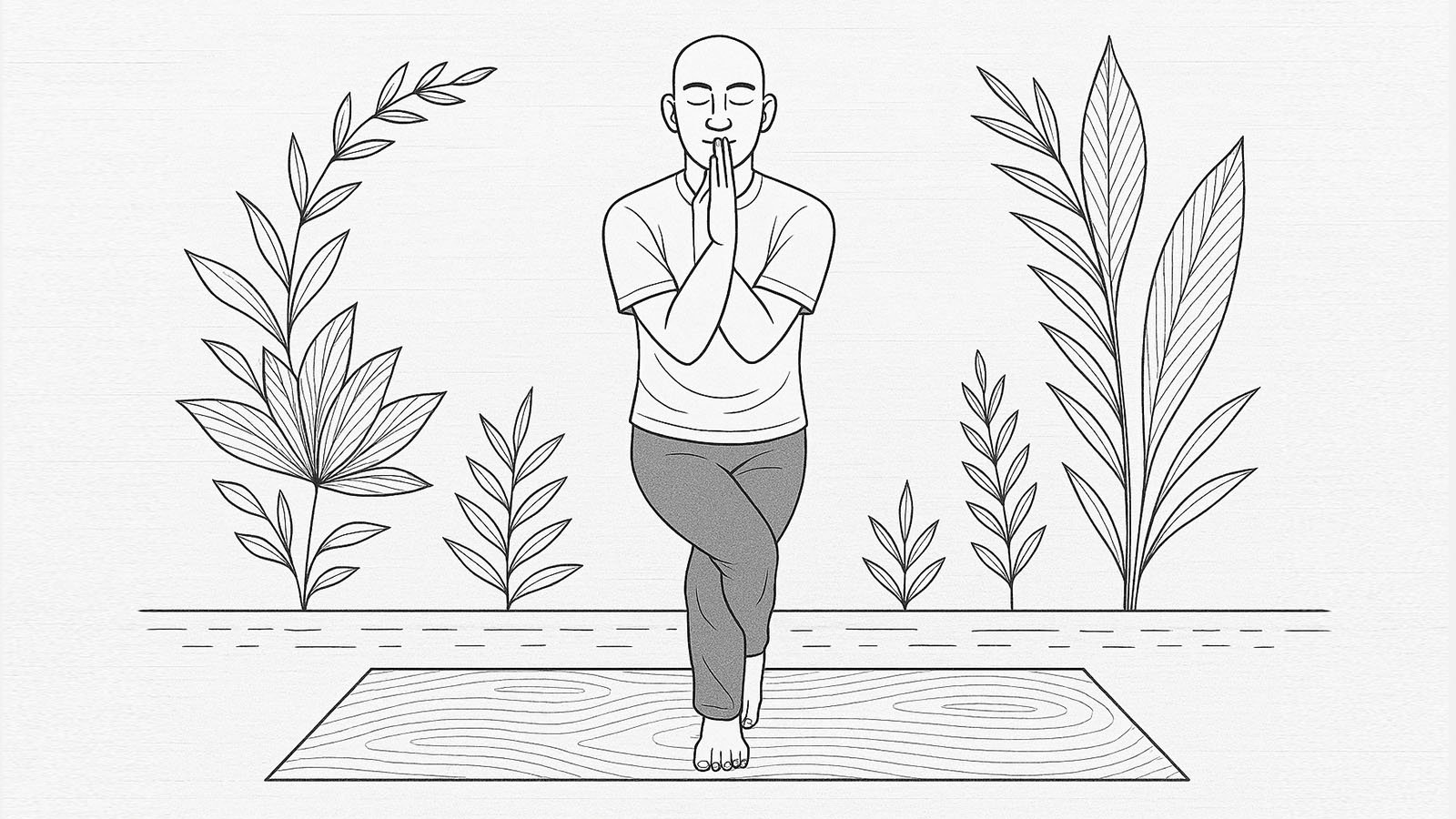
    Garudasana, known in Sanskrit as गरुड़ासन, is a standing balancing pose that symbolizes the focus and power of Garuda — the divine eagle and vehicle of Lord Vishnu. This posture involves entwining the arms and legs while maintaining stability, encouraging physical control and intense mental concentration. It stretches and strengthens the major joints while challenging the practitioner’s sense of balance and coordination.

    — Step-by-step Instructions —
    1. Stand in Tadasana with your spine straight and arms relaxed at your sides
    2. Shift your weight onto the left foot
    3. Bend your knees slightly and lift the right leg, crossing it over the left thigh
    4. Try to hook the right foot around the back of the left calf if possible
    5. Bring the arms forward, bend the elbows, and cross the right arm over the left
    6. Join the palms together or bring the backs of the hands to touch
    7. Keep the spine erect and gaze fixed at a point for balance
    8. Hold the posture while breathing normally
    9. Slowly release and return to the starting position
    10. Repeat the same steps on the opposite side
    — Physical Benefits  —
    • Improves balance and strengthens legs, ankles, and feet
    • Stretches shoulders, upper back, and thighs
    • Enhances flexibility in the wrists, knees, and hip joints
    • Stimulates blood flow and lymphatic circulation in joints
    • Tones the core and improves body coordination
    — Mental & Emotional Benefits  —
    • Enhances focus, concentration, and mental clarity
    • Develops patience and stability of the mind
    • Reduces anxiety by grounding scattered energy
    • Encourages mindfulness through body awareness
    — Precautions to keep in Mind —
    • Avoid if you have knee, ankle, or shoulder injuries
    • Pregnant women should avoid deep leg crossing
    • Women should avoid this pose during menstruation if it causes discomfort due to pressure in the lower body
    • Elderly practitioners or beginners with balance issues should use wall support or modify the position
    — Beginner’s Tips —
    • Start by crossing only the thighs if the full leg wrap is difficult
    • Use a wall for support or place the toes of the lifted foot on the floor
    • Practice arm movement separately before attempting the full pose
    — Best Time to Practice —
    • Morning practice helps activate focus and balance for the day
    • Can also be practiced in the evening to calm a restless mind
    — Advanced Variations —
    • Sink deeper into the posture for increased intensity and balance challenge
    • Hold the pose with eyes closed for internal awareness and control
    • Add slow breathing or internal retention if you are comfortable and stable

    — Wrapping Up —

    Garudasana is a powerful balancing posture that blends strength, flexibility, and mental steadiness. Like the focused gaze of the eagle, this asana requires unwavering attention and graceful coordination. When practiced regularly, it enhances joint health, stimulates circulation, and deepens the connection between breath and movement, making it a valuable addition to any standing sequence.

  • ARDHA CHANDRASAN (Crescent Posture)

    ARDHA CHANDRASAN (Crescent Posture)

    — Introduction —

    Ardha Chandrasana, known in Sanskrit as अर्धचन्द्रासन, translates to Half-Moon Pose. In traditional practice, this version is performed as a standing backbend while keeping the feet grounded and the arms extended overhead. It represents the calm, graceful, and expansive energy of the moon, and is often included in warm-up sequences to energize the spine and lungs.

    — Step-by-step Instructions —
    1. Stand upright with the heels together and the body relaxed.
    2. Inhale deeply and raise both arms overhead.
    3. Hold the breath internally and gently bend the upper body backward.
    4. Remain in the position as long as the breath is retained; return back only until the arms come overhead.
    5. After that, return to the starting position while exhaling.
    6. Repeat the practice five times.

      Note: While performing the backward bend, make sure to hold the posture only during internal breath retention. Do not inhale or exhale while bending backward or while returning from the posture, as doing so may create unnecessary strain and could be harmful.
    — Physical Benefits  —
    • Strengthens the spine, arms, thighs, and buttocks
    • Stretches abdominal muscles and opens the chest
    • Improves posture and spinal flexibility
    • Expands the lungs and enhances breathing capacity
    • Stimulates the digestive and reproductive organs
    — Mental & Emotional Benefits  —
    • Invokes calmness and gentle energy like the moon
    • Helps release stored emotional tension in the chest and heart area
    • Improves focus and mental clarity
    • Energizes the body and uplifts the mood
    — Precautions to keep in Mind —
    • Avoid in case of hernia, vertigo, spinal injuries, or recent abdominal surgery
    • People with high or low blood pressure should practice with caution
    • Women should avoid this pose during menstruation due to the backward bend and abdominal stretch
    • Elderly practitioners or those with limited spinal mobility should keep the bend mild and practice with support
    — Beginner’s Tips —
    • Keep the legs slightly apart for better balance if needed
    • Use a wall behind for support while bending
    • Focus on lengthening the spine before initiating the backward bend
    — Best Time to Practice —
    • Early morning is best to awaken the spine and open the chest
    • Can be practiced in the evening as a gentle energizer after a long day
    — Advanced Variations —
    • No Variations

    — Wrapping Up —

    Ardha Chandrasana is a graceful and energizing posture that strengthens the spine, expands the chest, and activates the lungs. When practiced with internal breath retention, it enhances the control of pranic energy and deepens mental focus. However, it is essential to maintain the backward bend only during the phase of breath retention and avoid breathing in or out while moving into or out of the posture, as doing so may cause strain. With mindful breathing and steady practice, this pose cultivates balance, lightness, and clarity—reflecting the calm yet powerful qualities of the moon.