Blog

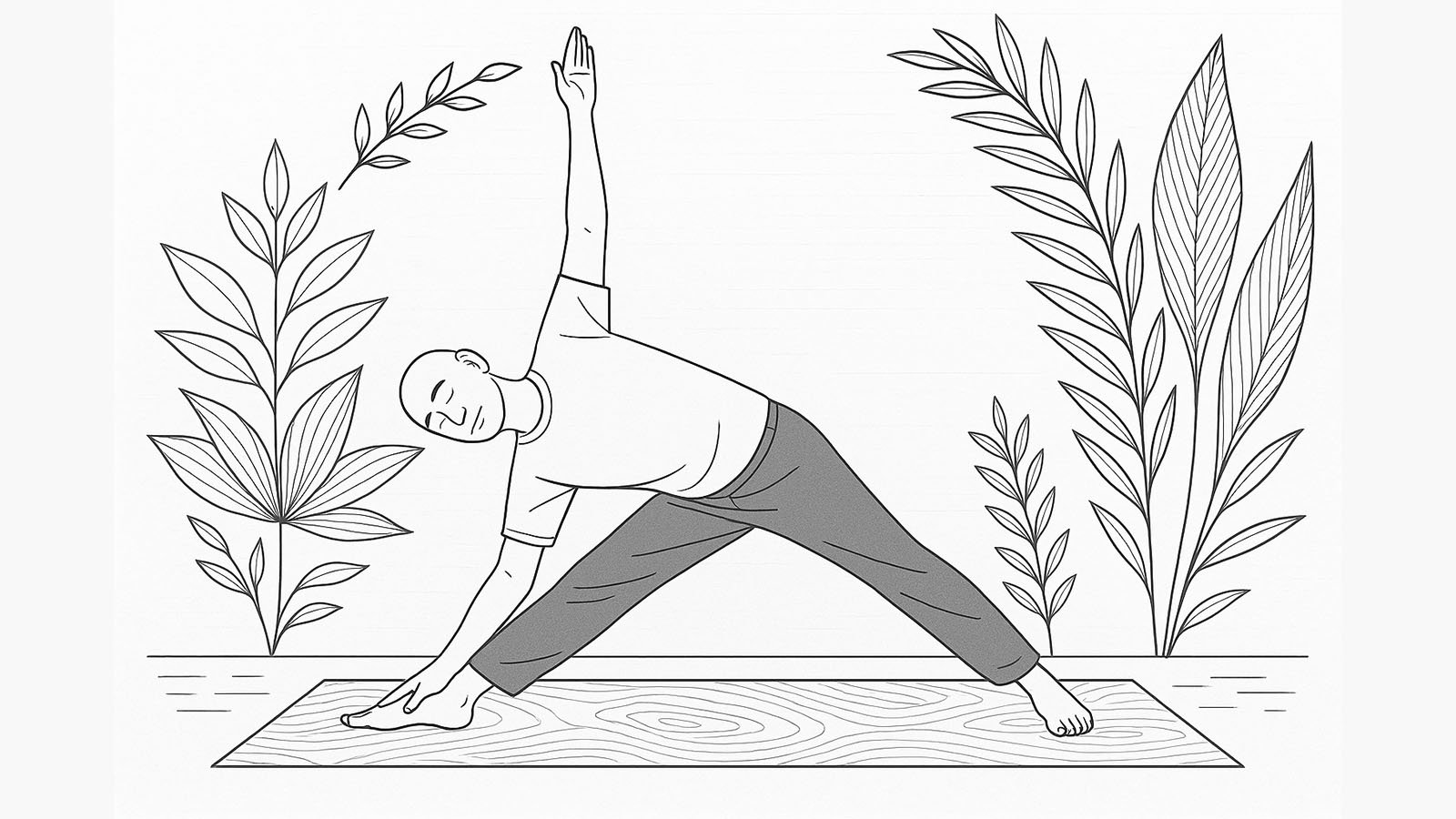
  • VIMUKH TRIKONASAN (Triangular Twist)

    VIMUKH TRIKONASAN (Triangular Twist)

    — Introduction —

    Vimukh Trikonasana, known in Sanskrit as विमुख त्रिकोणासन (Vimukh Trikoṇāsana), is a twisting variation of the classical Triangle Pose. “Vimukh” means turned away or facing backward, and “Trikona” means triangle. This pose is also widely known as Parivrtta Trikonasana (परिवृत्त त्रिकोणासन) — the Revolved Triangle Pose. It combines lateral extension with a deep spinal twist, promoting detoxification, balance, and stability.

    — Step-by-step Instructions —
    1. Stand with your feet placed wide apart, approximately three feet.
    2. Inhale and raise both arms sideways to shoulder height.
    3. As you exhale, bend forward from the hips while simultaneously rotating the torso to the right.
    4. Place the left hand on the right foot and extend the right arm upward, in line with the shoulders.
    5. Hold the final position during the period of external breath retention.
    6. Inhale and return to the upright standing position.
    7. Exhale again and repeat the movement, this time turning the torso to the left.
    8. Touch the left foot with the right hand and extend the left arm upward.
    9. Perform this posture alternately on both sides, repeating the sequence three times each side.
    — Physical Benefits  —
    • Enhances spinal flexibility and mobility
    • Strengthens legs, hips, and core muscles
    • Stimulates abdominal organs and supports digestion
    • Improves posture, balance, and coordination
    • Stretches hamstrings, calves, and shoulders
    — Mental & Emotional Benefits  —
    • Enhances focus and mental clarity
    • Promotes a sense of stability and alignment
    • Calms the mind and releases physical tension
    • Increases body awareness and breath control
    — Precautions to keep in Mind —
    • Avoid in case of spinal disc issues, hernia, or recent abdominal surgery
    • People with high blood pressure or vertigo should avoid deep forward bends
    • Women should avoid practicing this asana during menstruation due to the twisting and abdominal pressure involved
    • Children and elderly practitioners should perform this pose under supervision and with support
    • Do not force the twist; go only as far as is comfortable
    — Beginner’s Tips —
    • Use a yoga block under the lower hand for stability
    • Focus on lengthening the spine before attempting a deep twist
    • Keep the back heel grounded and legs strong for better balance
    — Best Time to Practice —
    • Morning practice is ideal to stimulate digestion and awaken the spine
    • Can also be practiced in the evening after food has been fully digested
    — Advanced Variations —
    • Reach the lower hand to the outside of the foot for a deeper stretch
    • Close the eyes for internal awareness and increased difficulty

    — Wrapping Up —

    Vimukh Trikonasana, or Parivrtta Trikonasana, is a powerful pose that combines strength, flexibility, and detoxification. This revolved triangle posture sharpens awareness, energizes the body, and brings equilibrium to both sides of the body. With regular practice, it builds both inner and outer stability, preparing the practitioner for deeper yogic exploration.
  • SHVETAGARUTASAN (Albatross Posture)

    SHVETAGARUTASAN (Albatross Posture)

    — Introduction —

    Shwet Garudasana, known in Sanskrit as श्वेत गरुड़ासन (Śveta Garuḍāsana), is a traditional yogic posture inspired by the purity and strength of Garuda — the divine eagle mount of Lord Vishnu. The term “Shwet” means white, signifying sattva (purity and balance), and “Garuda” symbolizes dynamic force, vision, and upliftment. This asana integrates movement and breath retention to develop stability, breath control, and awareness. It is distinct from the classical Garudasana (Eagle Pose) and is typically practiced in traditional yoga lineages.

    — Step-by-step Instructions —
    1. Stand with your feet spread about three feet apart
    2. Inhale and raise both arms sideways until they are at shoulder height, parallel to the ground
    3. Exhale slowly and bend forward at the hips until your upper body is parallel to the floor
    4. Hold the breath externally and maintain a straight gaze forward while staying in the final position
    5. Inhale and return to the original upright position with arms extended
    6. Repeat this movement five times, coordinating breath with motion
    7. The breathing sequence is: inhale while raising arms, exhale while bending forward, retain breath while holding the pose, and inhale while returning up
    — Physical Benefits  —
    • Strengthens the legs, hips, and lower back
    • Improves spinal alignment and flexibility
    • Enhances breath control and lung efficiency
    • Stimulates abdominal organs and digestion
    • Tones the muscles of the shoulders and upper back
    — Mental & Emotional Benefits  —
    • Encourages internal focus and steadiness
    • Increases clarity and presence of mind
    • Balances nervous energy and promotes calmness
    • Enhances pranic control and mindfulness during motion
    — Precautions to keep in Mind —
    • Avoid if you suffer from high blood pressure, hernia, or recent abdominal surgery
    • Women should avoid practicing this asana during menstruation,
    • Do not hold the breath beyond your natural capacity
    • Those with vertigo or balance issues should practice with caution
    • Keep the knees slightly bent if the hamstrings are tight
    — Beginner’s Tips —
    • Start with a smaller range of forward bend if flexibility is limited
    • Focus more on breath awareness than perfection of posture
    • Use a wall for balance support if necessary during the movement
    — Best Time to Practice —
    • Early morning is ideal, when the stomach is empty and the breath is calm
    • Can also be practiced in the evening for restoring balance and focus
    — Advanced Variations —
    • Hold the forward bend longer with deeper external breath retention (bahya kumbhak)
    • Perform with eyes closed to deepen internal awareness and balance

    — Wrapping Up —

    Shwet Garudasana is a meditative yet active posture that integrates dynamic movement with conscious breath retention. Rooted in yogic symbolism, it evokes the soaring strength and inner purity of Garuda. When practiced regularly, it cultivates awareness, vitality, and an unshakable inner focus, making it a valuable part of traditional yogic practice.

  • VIKRANTASAN (Warrior Posture)

    VIKRANTASAN (Warrior Posture)

    — Introduction —

    Vikrantasana, known in Sanskrit as विक्रान्तासन (Vikrāntāsana), is a powerful standing posture that embodies strength, courage, and inner resolve. The word “Vikranta” means heroic, courageous, or bold, while “Asana” means posture. This asana is visually and energetically similar to Virabhadrasana I (Warrior I Pose), expressing the spirit of a focused and valiant warrior.

    — Step-by-step Instructions —
    1. Stand upright with the spine straight.
    2. Spread your legs as wide as is comfortable, keeping both knees straight.
    3. Inhale and raise both arms overhead, bringing the palms together in Namaste.
    4. Turn the left foot outward so that the toes point to the left.
    5. As you exhale, bend the left knee and simultaneously rotate the torso to face the same direction as the bent knee.
    6. Keep the upper body lifted and stretched upward as you turn.
    7. Bend the left knee until it forms a right angle, with the thigh parallel to the floor.
    8. Gaze upward toward the joined hands.
    9. Ensure the right leg stays straight and the right foot remains flat and firmly grounded throughout the posture.
    10. Once the final position is reached, return to normal breathing.
    11. Maintain the posture for five steady, deep breaths.
    12. Then repeat the same steps on the opposite side, bending the right leg and keeping the left leg straight.
    — Physical Benefits  —
    • Strengthens legs, hips, back, and shoulders
    • Improves lung capacity and chest expansion
    • Enhances core stability and lower body endurance
    • Increases flexibility in the groin, hip flexors, and calves
    • Tones abdominal and spinal muscles
    — Mental & Emotional Benefits  —
    • Promotes courage and self-confidence
    • Builds emotional stability and determination
    • Encourages grounding and resilience
    • Enhances focus and inner strength
    • Reduces mental fatigue through strong breath-body coordination
    — Precautions to keep in Mind —
    • Avoid if suffering from knee, ankle, or hip injuries
    • Those with high blood pressure should avoid lifting arms too high or arching excessively
    • Pregnant practitioners should modify the stance and avoid deep lunges
    • Maintain alignment to prevent strain on the lower back
    — Beginner’s Tips —
    • Keep hands shoulder-width apart if joining the palms overhead is difficult
    • Use a wall or chair for support if balance is a challenge
    • Do not force the back foot too far out; adjust the stance based on comfort
    — Best Time to Practice —
    • Ideally practiced in the early morning for strength and focus
    • Can also be done in the evening to release stress and fatigue
    — Advanced Variations —
    • Close the eyes for increased internal focus and balance training.

    — Wrapping Up —

    Vikrantasana symbolizes heroic energy and inner bravery. Closely related to Virabhadrasana I, this posture embodies power, grace, and grounded determination. Practicing Vikrantasana regularly helps in building physical endurance and cultivating the fearless spirit of a true yogi.

  • VIMUKH KONASAN (Angular Twist Posture)

    VIMUKH KONASAN (Angular Twist Posture)

    — Introduction —

    Vimukh Konasana, known in Sanskrit as विमुख कोणासन (Vimukh Koṇāsana), Angular Twist Posture, is a lesser-known twisting standing pose that combines side extension with a backward torso twist. “Vimukh” means turned away or facing backward, “Kona” means angle, and “Asana” means posture. This pose promotes spinal mobility, core strength, and overall balance by engaging multiple muscle groups through rotation and stretch.

    — Step-by-step Instructions —
    1. Stand with your legs spread wide apart.
    2. Turn the left foot outward to face the left side.
    3. Bend the left knee so that the left shin becomes vertical and perpendicular to the floor.
    4. As you exhale, rotate your upper body to the left. At the same time, bend forward and bring the right armpit over the left knee, placing the right palm on the floor beside the left foot.
    5. Inhale and stretch the left arm forward, extending it horizontally over the head in line with the body.
    6. Keep the right leg straight and firmly extended throughout the pose.
    7. This posture should be entered using the breath cycle as described above. Once in the final position, resume normal breathing.
    8. Hold the pose for about five deep breaths while maintaining steady focus and alignment.
    9. Repeat the same steps on the opposite side, reversing the arms and legs.
    — Physical Benefits  —
    • Improves spinal flexibility and rotation
    • Strengthens legs, core, and obliques
    • Stimulates abdominal organs and enhances digestion
    • Opens the chest and shoulders
    • Enhances coordination between upper and lower body
    — Mental & Emotional Benefits  —
    • Increases body awareness and concentration
    • Promotes mental clarity and focus through balance and breath
    • Helps relieve mental fatigue and sluggishness
    • Develops the ability to stay present and aligned
    — Precautions to keep in Mind —
    • Avoid if you have spinal disc issues or recent abdominal surgery
    • People with shoulder or neck injuries should modify arm positions
    • Those with dizziness or vertigo should practice under supervision
    • Don’t force the twist; work within a comfortable range
    — Beginner’s Tips —
    • Use a block under the lower hand for better support
    • Focus on elongating the spine before twisting
    • Keep the legs strong and grounded to avoid collapsing the chest
    — Best Time to Practice —
    • Morning practice is ideal to awaken the spine and digestive organs
    • Can also be done in the evening with awareness and control after meals have digested
    — Advanced Variations —
    • Try binding the arms around the thigh if flexibility allows
    • Perform the pose with the back heel lifted for deeper rotation
    • Hold longer with slow breathing to improve stamina and control

    — Wrapping Up —

    Vimukh Konasana is a unique blend of extension and rotation that awakens the spine, tones the midsection, and enhances mental focus. Though not commonly practiced, it brings immense benefits when integrated into a thoughtful yoga sequence. With regular practice, it cultivates stability, mobility, and deeper body-mind alignment.

  • KONASAN (Angular Posture)

    KONASAN (Angular Posture)

    — Introduction —

    Konasan (कोणासन), or Parsvakonasana (पार्श्वकोणासन) , also known as Angular Posture, is a powerful standing pose that combines strength, stretch, and stability. “Parshva” means side, “Kona” means angle, and “Asana” means posture. This asana strengthens the legs and stretches the sides of the body while enhancing lung capacity and balance.

    — Step-by-step Instructions —
    1. Begin in a standing position and spread your legs 3 to 4 feet apart
    2. Turn the right foot out 90 degrees and the left foot slightly in
    3. Bend the right knee so that the thigh is parallel to the floor, keeping the knee above the ankle
    4. Extend both arms sideways in line with the shoulders
    5. Inhale and as you exhale, lower the right hand down to the floor (or block) beside the right foot
    6. Simultaneously stretch the left arm over the left ear, keeping the arm in line with the left side of the body
    7. Turn your head to look up at the raised arm, if comfortable
    8. Keep the back leg straight and firmly grounded
    9. Hold the position while breathing normally, then return to standing and repeat on the opposite side
    — Physical Benefits  —
    • Strengthens the legs, knees, and ankles
    • Stretches the groin, spine, waist, chest, and shoulders
    • Tones abdominal organs and aids digestion
    • Increases stamina, flexibility, and endurance
    • Opens the hips and improves body alignment
    — Mental & Emotional Benefits  —
    • Enhances focus and concentration
    • Encourages grounding and mental stability
    • Reduces fatigue and stress
    • Increases awareness of breath and body movement
    — Precautions to keep in Mind —
    • Avoid if suffering from high or low blood pressure
    • Those with neck or shoulder injuries should modify the arm position
    • People with balance issues may use a block or wall support
    • Consult a doctor if you have knee or hip problems
    — Beginner’s Tips —
    • Place the bottom hand on a block if the floor is too far
    • Do not force the front thigh to be parallel — work gradually
    • Keep the back heel firmly pressed down for better stability
    — Best Time to Practice —
    • Early morning on an empty stomach is ideal
    • Can also be practiced in the evening after a gap of 3–4 hours from the last meal
    — Advanced Variations —
    • Try binding the hands behind the back if flexibility allows
    • Deepen the bend in the front knee for a stronger stretch
    • Close the eyes to improve internal balance and body awareness

    — Wrapping Up —

    Parsvakonasana is a dynamic pose that builds strength, length, and stability in the body while focusing the mind. Regular practice opens up the side body and hips, builds endurance, and provides a steady foundation for deeper yoga practices.

  • TRIKONASAN (Triangle Pose)

    TRIKONASAN (Triangle Pose)

    — Introduction —

    Trikonasana, (त्रिकोणासन) also known as Triangle Pose, is a foundational standing pose in yoga that stretches and strengthens various muscle groups simultaneously. The word “Trikona” means triangle, and “Asana” means posture. This pose mimics the shape of a triangle and enhances stability, flexibility, and focus.

    — Step-by-step Instructions —
    1. Stand upright with legs wide apart (around 3 to 4 feet)
    2. Turn the right foot out 90 degrees and slightly turn the left foot in
    3. Extend both arms sideways in line with the shoulders, palms facing down
    4. Inhale and stretch the torso to the right side, then exhale and bend down to place the right hand on the right shin, ankle, or floor beside the foot
    5. Raise the left arm straight up, in line with the shoulders, and turn the head to look at the left thumb
    6. Keep both legs straight and chest open
    7. Breathe normally and hold the posture steadily
    8. To release, inhale and come back up with arms stretched, then lower the arms and repeat on the other side
    — Physical Benefits  —
    • Stretches the legs, hips, spine, and waist
    • Improves flexibility in the hamstrings and hips
    • Strengthens thighs, knees, and ankles
    • Stimulates abdominal organs and aids digestion
    • Helps relieve backache and sciatica
    — Mental & Emotional Benefits  —
    • Improves body awareness and posture
    • Enhances concentration and stability of the mind
    • Reduces anxiety and fatigue
    • Promotes a sense of balance and clarity
    — Precautions to keep in Mind —
    • Avoid if suffering from migraine, low blood pressure, or diarrhea
    • People with neck problems should keep the head in a neutral position
    • Do not strain the knees or bend the front leg
    • Those with recent hip or spine injuries should consult a doctor before practicing
    — Beginner’s Tips —
    • Use a yoga block under the hand if reaching the floor is difficult
    • Focus more on alignment than depth of the stretch
    • Keep the knees micro-bent if the hamstrings are tight
    — Best Time to Practice —
    • Early morning with an empty stomach is ideal
    • Can also be practiced in the evening after 3–4 hours of the last meal
    — Advanced Variations —
    • Place the lower hand on the outside of the front foot to deepen the stretch
    • Try the pose with a bind if flexibility allows
    • Close the eyes for added balance and awareness challenge

    — Wrapping Up —

    Trikonasana is a graceful and energizing posture that builds a solid foundation for balance, flexibility, and inner calm. Practicing it regularly helps open the body and mind, allowing energy to flow freely while grounding the practitioner with clarity and stability.